
Setup the IBC connection
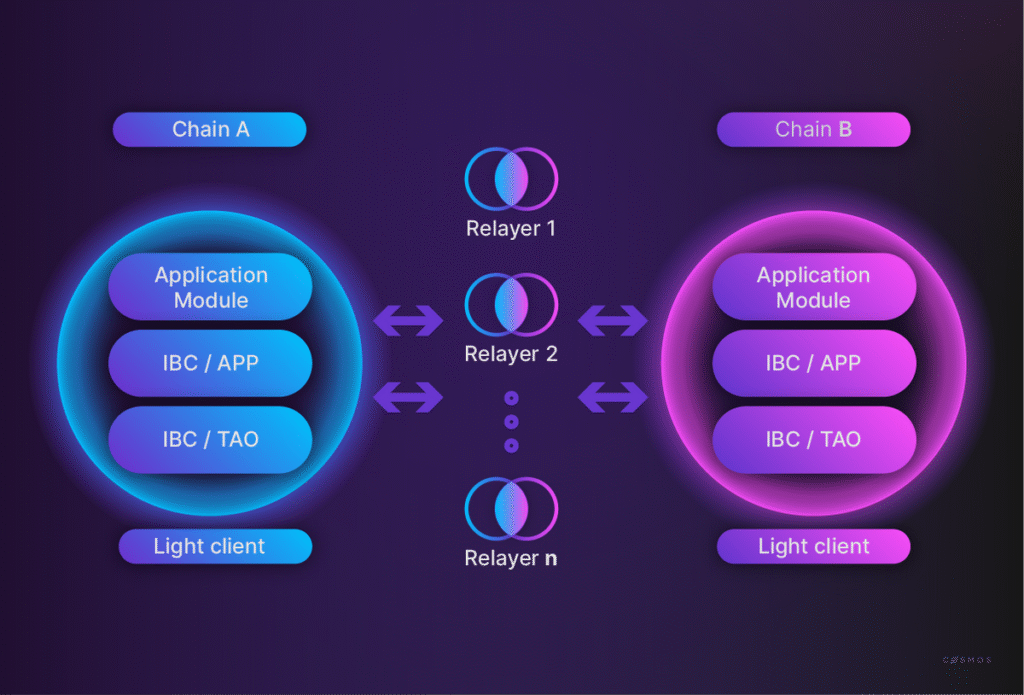
Connecting two Cosmos SDK chains requires establishing a bidirectional communication path before any data or tokens can move. The Inter-Blockchain Communication (IBC) protocol handles this through a strict handshake sequence. This process ensures both chains agree on the connection parameters, channel identifiers, and counterparty details.
Think of this setup like establishing a secure phone line between two offices. Before you can transfer documents (packets), both sides must agree on the phone number (connection ID) and the specific extension (channel ID). The handshake verifies that both chains are running compatible IBC versions and can mutually trust each other's state.
The implementation relies on the ibc module within the Cosmos SDK. You will configure the connection and channel states in your chain's genesis or via governance proposals. The protocol enforces a four-step handshake: INIT, TRYOPEN, ACK, and OPEN. Each step must be completed by both the source and destination chains for the channel to become active.
Step 1: Initialize the connection
The first step involves creating a connection state on both chains. You must specify the client ID, which represents the light client used to verify the other chain's state. This client tracks the consensus state, allowing one chain to trust the other's block headers.

On Chain A, create a client that tracks Chain B's consensus state. This client is the foundation of trust. It allows Chain A to verify proofs of Chain B's state. You typically use a Tendermint light client for this purpose.

Use the MsgConnectionOpenInit message on Chain A. This message includes the client ID and the counterparty client ID (if known). This creates a INIT state on Chain A, waiting for Chain B to acknowledge the connection.
Chain B receives the proof of Chain A's INIT state. It responds with MsgConnectionOpenTry, moving to TRYOPEN. Chain A then verifies this and moves to ACK. Finally, Chain B completes the process with MsgConnectionOpenConfirm, resulting in an OPEN state on both chains.
Once the connection is open, you can proceed to create channels. Each channel represents a specific application path, such as token transfers or IBC middleware. The channel handshake follows a similar four-step process, ensuring that both chains agree on the ordering (ordered vs unordered) and the counterparty channel ID. This layered approach allows multiple applications to run over a single connection securely.
Configure light clients for trust
How Cosmos IBC Connects Chains works best as a sequence, not a scramble through settings. Do the minimum first: confirm compatibility, connect the core hardware, update only when needed, and test the result before adding optional features. That order keeps the task understandable and makes failures easier to isolate. After each step, pause long enough for the interface to finish syncing. Many setup problems are timing problems disguised as configuration problems. If the same step fails twice, record the exact error, restart the smallest affected piece, and retry before moving deeper.

How escrow accounts prevent double-spending
Cosmos IBC treats cross-chain token transfers like a secure courier system rather than a direct handoff. When you initiate a transfer from Chain A to Chain B, the tokens don't vanish from your account immediately. Instead, they are locked in an escrow account on the source chain. This account acts as a holding cell, ensuring the tokens are removed from circulation on Chain A while they are in transit. This mechanism is the first line of defense against double-spending, as the same tokens cannot be spent or transferred again on the origin chain while they are pending delivery.
The process follows a strict sequence of packet acknowledgment to guarantee finality. Below is the step-by-step flow of how the protocol handles these locked assets.
The sender initiates a transfer via the IBC transfer module. The specified amount of native tokens is moved from the sender's balance into a dedicated escrow account associated with the IBC channel. If the escrow account does not yet exist on the source chain, the protocol creates it automatically. The tokens are now effectively "locked" and unavailable for any other use.
Once the tokens are secured in escrow, the source chain generates a packet containing the transfer details: the token denomination, amount, sender address, and the destination chain ID. This packet is placed into the IBC relay path and sent to the relayer network. The relayers monitor the source chain for new packets and broadcast them to the destination chain.
The destination chain receives the packet and verifies its authenticity against the source chain's state root. If the packet is valid, the IBC transfer module on the destination chain mints the corresponding wrapped tokens (or credits native tokens if the channel is for a native asset) to the recipient's address. The tokens are now available for use on the destination chain.
After the destination chain successfully credits the recipient, it sends an acknowledgment packet back to the source chain. This acknowledgment is relayed back to the origin. Upon receiving this confirmation, the source chain's IBC module permanently burns or removes the locked tokens from the escrow account. This final step closes the loop, ensuring the tokens are fully transferred and no longer exist in a pending state.
This escrow-and-acknowledge model ensures that tokens are never duplicated. If the destination chain fails to acknowledge receipt within a specified timeout period, the tokens are automatically refunded to the sender's original address on the source chain. This safety net prevents tokens from being lost in transit if network congestion or relayer failure interrupts the process.
Avoid common integration errors
Cross-chain communication is fragile because it spans two independent execution environments. A packet sent from Chain A must survive the journey to Chain B without timing out, getting stuck, or being misinterpreted. Most integration failures come from three predictable mistakes: ignoring timeouts, mishandling channel closures, and assuming synchronous execution.
Timeout handling
IBC packets have a TimeoutHeight and a TimeoutTimestamp. If neither is met before the packet reaches the counterparty, the relayer marks it as timed out and refunds the sender. Developers often set these values too loosely, leading to stuck funds that sit in limbo for days, or too strictly, causing valid transactions to fail during network congestion.
Always calculate timeouts based on the current block height and timestamp, adding a buffer for expected relayer latency. Never hardcode a static timeout unless the target chain’s block time is perfectly predictable.
Warning: If you do not handle timeout refunds in your smart contract logic, users will lose access to their tokens when packets expire. Ensure your contract can accept the refund packet and restore the original state.
Channel closure errors
Channels can be closed by either side if they detect a misbehavior or if they manually trigger a closure. If your application assumes a channel is always open, it will fail when the counterparty closes it. This often happens during upgrades or when security vulnerabilities are discovered.
Monitor channel status continuously. If a channel closes, your application should either pause operations or switch to a fallback channel if one is available. Do not ignore closure events; they are critical signals that the current communication path is no longer valid.
Synchronous vs. asynchronous execution
IBC is asynchronous by design. When you send a packet, your transaction completes immediately, but the result arrives later via a callback. Many developers mistakenly treat IBC calls as synchronous, expecting the balance to update instantly in the same block.
This misunderstanding leads to race conditions where downstream logic runs before the packet is acknowledged. Always structure your code to handle the RecvPacket acknowledgment separately from the initial send. Use events or state checks to confirm the packet’s arrival before proceeding with dependent actions.
Verify the cross-chain link
Before moving production assets, you must validate that the IBC connection is stable and that packets are flowing without loss. A handshake is only the beginning; you need to confirm that the relayer is actively processing blocks and that the channels are open on both sides.
Use this checklist to confirm the integrity of your cross-chain setup:
-
Check relayer metrics: Ensure the relayer process is running and reporting recent packet acknowledgments (e.g., via rly metrics or Prometheus).
-
Verify channel state: Run ibc query channel connection on both chains to confirm the channel status is OPEN and not TRYOPEN or CLOSED.
-
Test a small transfer: Send a minimal amount of tokens (e.g., 1 uatom) from Chain A to Chain B. Confirm the balance updates on the destination chain within the expected timeout period.
-
Inspect packet logs: Review the relayer logs for any ACK failures or timeout errors. A healthy connection should show a stream of successful acknowledgments.
If the transfer fails, check the timeout height on the source chain. IBC packets expire if they are not acknowledged within the specified block height, which can happen if the destination chain is congested or the relayer is lagging.
Common ibc integration: what to check next
Developers often encounter specific hurdles when connecting chains using the Inter-Blockchain Communication (IBC) protocol. Below are answers to the most frequent technical questions about IBC mechanics, comparisons with other ecosystems, and implementation details.
No comments yet. Be the first to share your thoughts!