
What defines Cosmos IBC 2026
The Cosmos ecosystem has shifted from a siloed network of sovereign zones to a unified interoperable layer. In 2026, the Inter-Blockchain Communication (IBC) protocol no longer limits itself to native Cosmos chains. Instead, it serves as the bridge connecting over 200 public networks, including Solana, Ethereum Layer 2s, and various rollups. This expansion is driven by new IBC light clients that verify consensus across heterogeneous blockchains without relying on centralized relayers.
This architectural shift means IBC is no longer just a connector for similar chains. It is now the primary mechanism for cross-chain value transfer in a fragmented market. Developers can build applications that draw liquidity and security from multiple ecosystems simultaneously, treating them as a single unified state. The result is a network effect that prioritizes interoperability over isolation.
To understand the scale of this integration, it helps to look at the current market activity surrounding the Cosmos hub.
The growth in IBC transaction volume mirrors the broader adoption of these cross-chain connections. As more external chains adopt IBC light clients, the utility of the Cosmos hub expands beyond its native token. This creates a more robust infrastructure for institutions seeking secure, performant blockchain solutions for a decentralized future.
New light clients for Solana and EVM
The Cosmos Inter-Blockchain Communication (IBC) protocol has long been the gold standard for secure, trustless cross-chain messaging, but it was previously limited to the Cosmos ecosystem. In 2026, this boundary dissolves. By introducing new light clients for Solana and Ethereum Virtual Machine (EVM) L2s, IBC breaks the silo that kept these massive networks isolated from the Cosmos stack.
This technical breakthrough allows IBC to connect directly to non-Cosmos chains. Instead of relying on centralized bridges or wrapped assets, IBC light clients verify the consensus state of Solana and EVM chains natively. This means that liquidity and data can flow freely between the Cosmos ecosystem and the broader blockchain landscape without compromising security.
The significance of this expansion cannot be overstated. For years, liquidity has been fragmented across competing blockchains. By connecting to Solana and EVM L2s, IBC reduces this fragmentation, allowing users and developers to access a unified liquidity pool. This move positions IBC not just as a protocol for Cosmos, but as the universal connectivity layer for the entire blockchain industry.
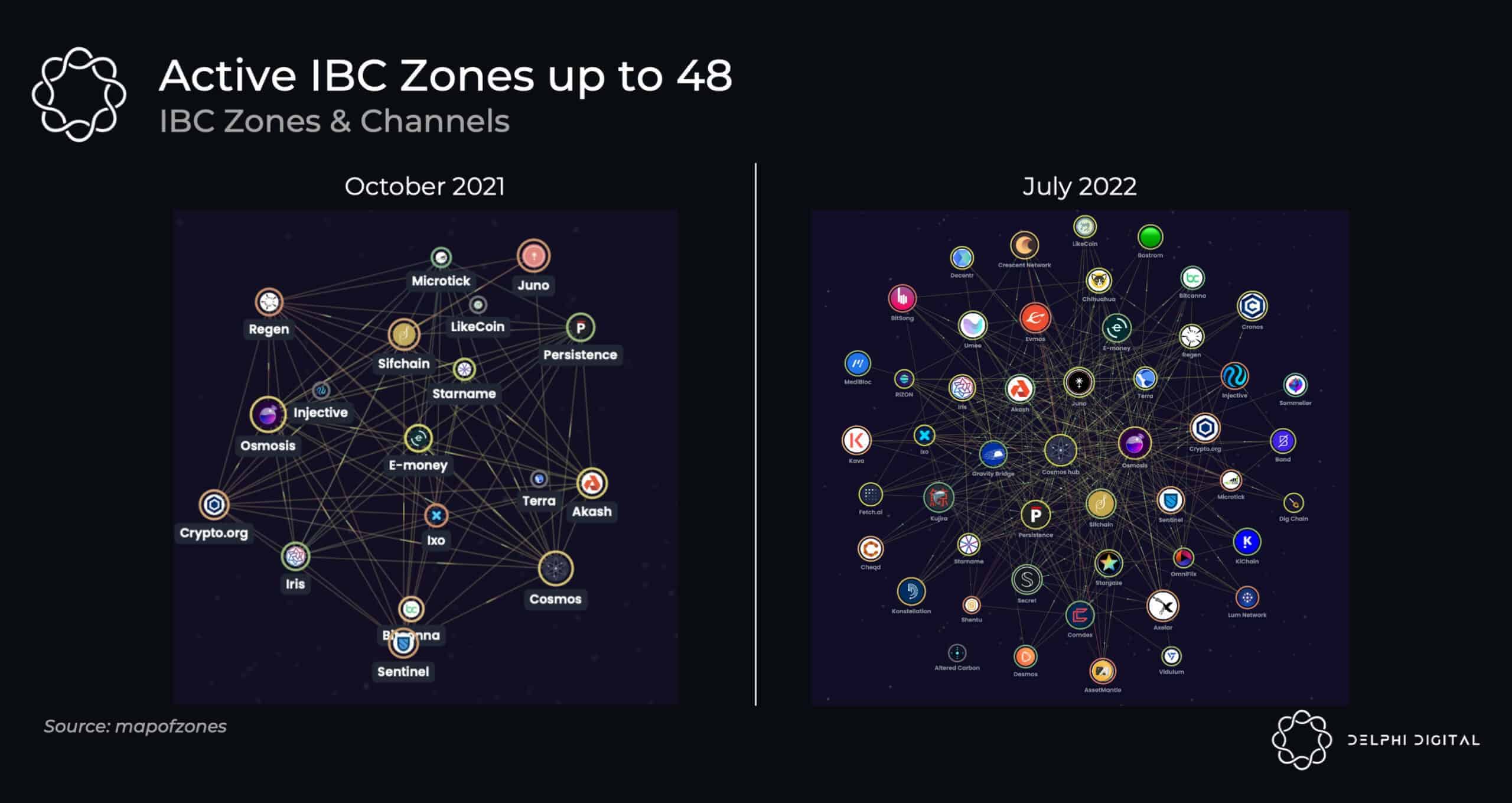
The Cosmos Stack architecture, as described by the Interchain Foundation, is designed for scalable and interconnected Layer 1 blockchains. With these new light clients, the promise of a fully interconnected internet of blockchains becomes a reality. Users can now interact with Solana programs or EVM applications directly from their Cosmos wallets, using IBC as the secure transport layer.
This development marks a new era for cross-chain interoperability. It moves the industry beyond the risky, centralized bridge models of the past and toward a future where security and usability are not mutually exclusive. As IBC expands to support these major networks, it sets a new standard for how blockchains should communicate with each other.
Relayer Efficiency and Cost Reductions
The viability of high-frequency DeFi on the Cosmos IBC chain hinges on the performance of relayers—the independent nodes that verify and relay messages between chains. In 2026, infrastructure upgrades have dramatically lowered both the latency and the cost of these cross-chain transactions, turning what was once a slow, expensive process into a near-instantaneous utility.
Lower Latency for Real-Time Trading
Previous iterations of IBC suffered from noticeable delays as relayers processed blocks sequentially. New optimizations in the relayer software, particularly those documented in the canonical cosmos/ibc repository, have introduced parallel processing capabilities. This allows multiple packet validations to occur simultaneously, reducing the time it takes for a transaction to settle on a destination chain from minutes to seconds. For traders executing arbitrage strategies across the IBC ecosystem, this speed reduction is critical; it closes the window for front-running and ensures price consistency across chains.
Drastically Reduced Transaction Costs
Beyond speed, the economic barrier to entry has been significantly lowered. Optimized gas estimation algorithms and better batching of IBC packets mean that the cost per transaction has dropped by an order of magnitude. This makes micro-transactions and high-frequency trading strategies economically feasible, which were previously unviable due to high relay fees. The Interchain Standards (ICS) have been refined to support more efficient packet formats, further squeezing out unnecessary overhead.
Comparison: Pre-2026 vs. 2026 Relayer Performance
The following table illustrates the general shift in relayer capabilities, highlighting the efficiency gains that underpin the current IBC ecosystem.
| Metric | Pre-2026 | 2026 |
|---|---|---|
| Packet Latency | 30–120 seconds | < 3 seconds |
| Cost Per Packet | $0.50–$2.00 | $0.01–$0.05 |
| Relayer Throughput | Sequential processing | Parallel processing |
These improvements have transformed IBC from a theoretical interoperability standard into a robust, high-performance network capable of supporting complex, real-time financial applications.
Multi-chain DeFi use cases in 2026
Cross-chain lending has evolved from experimental hacks to a core infrastructure layer. Developers now use IBC 2026 to build lending markets that accept assets from multiple chains as collateral without wrapping them into synthetic tokens. This reduces counterparty risk and eliminates the need for centralized bridges that often become attack vectors.
Decentralized exchanges (DEXs) leverage IBC’s atomic swaps to offer deeper liquidity pools. Instead of relying on a single chain’s liquidity, traders can access prices aggregated across the Cosmos ecosystem. This means better execution for large orders and lower slippage, as capital flows freely between zones like Osmosis, Celestia, and the Cosmos Hub.
Asset bridging has also shifted toward trust-minimized solutions. Rather than locking tokens in a centralized vault, IBC 2026 enables light clients to verify state across chains. This allows users to move assets like ATOM or TIA between networks with cryptographic proof of ownership, ensuring that the asset exists on the destination chain before it is removed from the source.
Cosmos Hub upgrades and governance
Use this section to make the Cosmos IBC decision easier to compare in real life, not just on paper. Start with the reader's actual constraint, then separate must-have requirements from details that are merely nice to have. A practical choice should survive normal use, maintenance, timing, and budget. If a recommendation only works in an ideal situation, call that out plainly and give the reader a fallback path.
The simplest way to use this section is to write down the must-have criteria first, then compare each option against those criteria before weighing nice-to-have features.
Common questions about IBC interoperability
Is IBC secure?
The Inter-Blockchain Communication protocol relies on light clients to verify state across chains. This means each chain independently validates proofs from the other, rather than trusting a central authority. Security is tied to the individual chains involved; if one chain is compromised, the light client on the other chain will detect the invalid state transition. This design ensures that data integrity is maintained without a single point of failure.
What assets can I transfer?
IBC supports more than just native tokens. It can transfer any data packet, including fungible tokens (IBC tokens), non-fungible tokens (NFTs), and arbitrary smart contract state. When you send an asset, it is typically locked in a module on the source chain and minted in a corresponding representation on the destination chain. This "lock-and-mint" mechanism ensures the total supply remains consistent across the network.
How hard is it to start using IBC?
For end-users, using IBC has become significantly more streamlined with the introduction of relayer services and integrated wallets. You no longer need to manually run relayers to bridge assets. Most modern Cosmos SDK wallets now support IBC transfers directly, treating cross-chain movements as standard transactions. However, developers building new chains must still implement the IBC protocol stack, which requires a solid understanding of the underlying consensus and state machine mechanics.
No comments yet. Be the first to share your thoughts!