
What is Cosmos IBC 2.0
Cosmos IBC 2.0 (also known as IBC v2) represents a fundamental redesign of the Inter-Blockchain Communication protocol that has long served as the backbone of the Cosmos ecosystem. While the original "IBC Classic" successfully enabled asset and data transfer between independent Cosmos SDK chains, it remained tightly coupled to the specific architectural patterns of that ecosystem. IBC 2.0 breaks these constraints, creating a streamlined framework that can operate across fundamentally different blockchain environments.
The most significant shift in this upgrade is its ability to connect gas-metered environments like Ethereum and Solana. Previously, interoperability was largely confined to chains built with the Cosmos SDK, which share similar state machine and account models. IBC 2.0 introduces simplified architecture and zero-knowledge light clients that allow these disparate networks to verify each other's state without requiring deep, native integration. This means a decentralized application on Ethereum can now communicate with a high-throughput chain like Solana through the Cosmos IBC protocol, treating them as peers rather than isolated silos.
This expansion is not just about adding new connections; it is about reducing the friction of implementation. By abstracting away the complex cryptographic proofs required for cross-chain verification, IBC 2.0 makes interoperability dramatically simpler to implement on any type of network. Developers no longer need to build bespoke bridges or rely on trusted third-party relayers for every new connection. Instead, they can leverage a standardized, secure protocol that works consistently whether the counterpart chain is gasless, gas-metered, or uses a completely different consensus mechanism.
The result is a more unified digital asset landscape. Users can move value and data across a wider variety of blockchains with greater security and lower overhead. This evolution transforms the Cosmos ecosystem from a collection of interconnected islands into a true hub for universal interoperability, setting the stage for a multi-chain future where boundaries between different ledger technologies become increasingly irrelevant.
How IBC 2.0 simplifies connections
IBC 2.0 removes the rigid structure that made previous versions difficult to implement. The old standard required chains to agree on specific data formats, which forced developers to build custom adapters for every new connection. This created a bottleneck where adding a single chain often meant weeks of engineering work to ensure compatibility.
The new version is encoding agnostic. This means IBC 2.0 does not care what format your data uses. Whether you are using JSON, Protobuf, or a custom schema, the protocol handles the transfer without requiring you to translate your data into a universal standard first. This flexibility allows developers to keep their existing data structures intact.
Connection creation has also been streamlined. In the previous iteration, setting up a channel involved multiple complex steps and heavy reliance on light client validation for every packet. IBC 2.0 retains the security of light clients but simplifies the lifecycle. The permissionless relay model remains, but the overhead for establishing and maintaining channels is significantly lower.
By stripping away architectural complexity, IBC 2.0 reduces the cost and time required to interconnect blockchains. Developers can now focus on building applications rather than wrestling with interoperability infrastructure. This shift makes it easier for new chains to join the Cosmos ecosystem and for existing ones to expand their reach.
ZK light clients reduce verification costs
Verifying the state of another blockchain has traditionally been the most expensive part of cross-chain communication. On Ethereum, where gas fees are high, running a full light client node to validate incoming IBC packets often cost more than the value of the assets being transferred. This economic barrier kept many Cosmos chains isolated from the Ethereum ecosystem, as the transaction costs were simply prohibitive for everyday use.
The solution lies in Succinct’s Processor SP1, a zero-knowledge virtual machine (zkVM) that transforms how verification works. Instead of requiring Ethereum nodes to perform complex, resource-heavy computations to check the validity of a Cosmos block header, SP1 generates a compact cryptographic proof. This proof attests that the data is correct without revealing the underlying work, allowing Ethereum to verify the transaction with minimal computational effort.
By shifting the heavy lifting off-chain to the zkVM, the gas cost for verifying light clients drops dramatically. This efficiency makes IBC transactions affordable on Ethereum, turning what was once a theoretical possibility into a practical reality for users and developers. The upgrade simplifies the implementation process, allowing any network—not just Cosmos SDK chains—to integrate interoperability without building custom, expensive verification infrastructure.
This approach removes the friction that previously hindered widespread adoption. With verification costs lowered, cross-chain interactions become viable for smaller transactions and higher-frequency use cases, expanding the utility of the Cosmos ecosystem beyond its native chains.
Moving Beyond the Cosmos Ecosystem
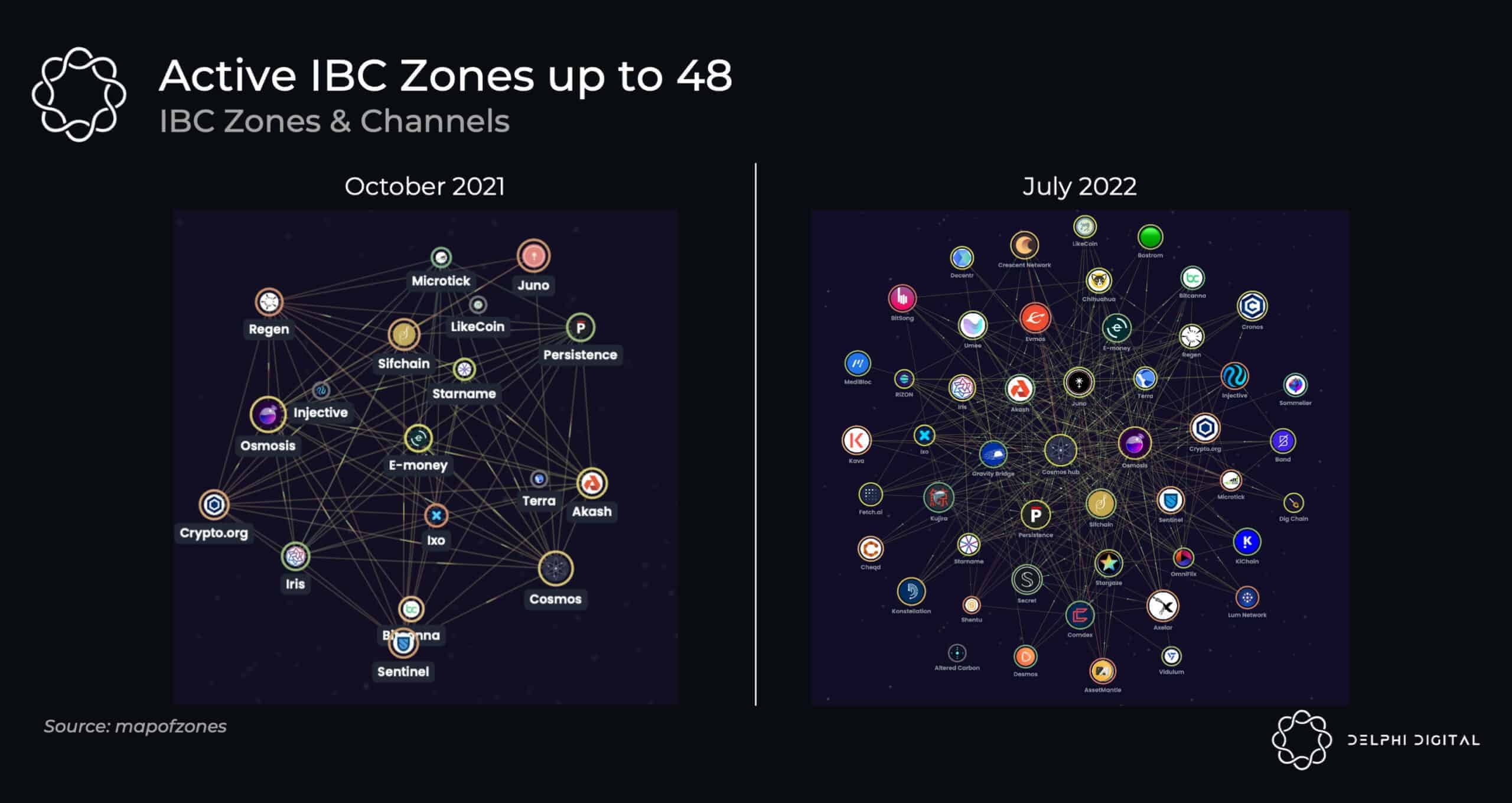
For years, IBC functioned as a powerful but contained highway, connecting chains within the Cosmos galaxy. IBC 2.0 changes that by extending the protocol’s reach to Ethereum and Solana, effectively turning a local network into a universal bridge. This expansion removes the need for complex, multi-hop routing through Cosmos hubs when moving assets between Ethereum and Solana.
The bridge to Ethereum relies on solidity-ibc-eureka, a smart contract implementation that allows Ethereum dApps to speak the IBC language directly. Instead of wrapping tokens in synthetic forms or relying on trusted custodians, Ethereum contracts can now verify IBC packets natively. This approach simplifies the developer experience significantly, as it reduces the layers of abstraction and security assumptions required for cross-chain communication.
Solana integration follows a similar path, enabling direct interaction between Solana programs and IBC-compatible chains. By supporting encoding-agnostic packet formats, IBC 2.0 ensures that chains with different architectural styles can interoperate without forcing a standardized, one-size-fits-all data structure. The result is a more fluid internet of value where liquidity and data flow freely between the two largest ecosystems, rather than being trapped behind walled gardens.
No comments yet. Be the first to share your thoughts!