
What is Cosmos IBC?
The Inter-Blockchain Communication (IBC) protocol is the standard for trustless data and token transfer between independent blockchains. Think of it as a universal shipping language for the Cosmos ecosystem. Just as standard container sizes allow cargo to move seamlessly between ships, trains, and trucks, IBC allows distinct chains to exchange information without relying on centralized intermediaries or wrapped assets.
At its core, IBC enables chains to send and receive any type of data, provided it is encoded in bytes. This capability extends beyond simple token swaps. It allows for cross-chain smart contract execution, decentralized identity verification, and synchronized state updates. When a chain speaks IBC, it can verify proofs from another chain, ensuring that actions taken on one network are securely recognized on another.
By 2026, this protocol has become the foundational layer for the Cosmos ecosystem. It connects dozens of independent blockchains, creating a network of networks. Instead of competing in isolated silos, chains like Osmosis, Celestia, and dYdX use IBC to share liquidity and security. This interoperability allows developers to build applications that leverage the specific strengths of multiple chains while maintaining a unified user experience.
The result is a more resilient and flexible infrastructure. Users can move assets across chains with predictable fees and finality, while developers can compose complex financial primitives that span multiple environments. IBC transforms independent blockchains into a cohesive, interconnected system.
How IBC 2026 Connects 200+ Networks
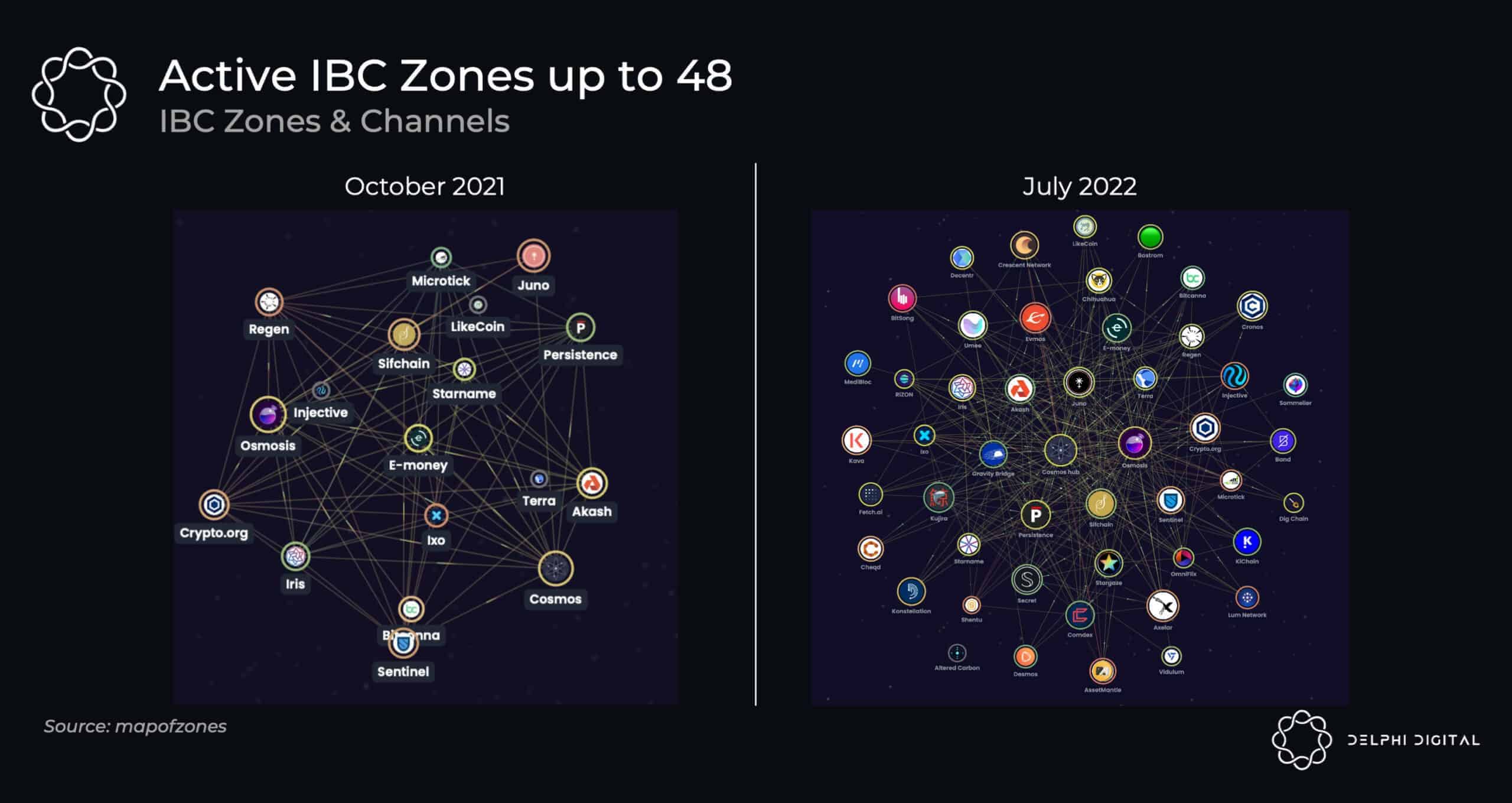
The Cosmos ecosystem has expanded far beyond its original core. Today, the Inter-Blockchain Communication protocol links over 200 public networks, including dozens of private consortiums. This scale represents a shift from isolated blockchains to a truly interconnected digital economy.
While IBC began with Cosmos SDK chains, the 2026 landscape includes critical integrations with external ecosystems. IBC now bridges to Solana, Ethereum L2s, and various rollups. These connections allow assets and data to flow seamlessly between previously siloed networks, creating a unified multi-chain environment.
This expansion is not just about quantity. It is about utility. By connecting diverse architectures, IBC enables developers to build applications that leverage the strengths of multiple chains without compromising on security or user experience.
How DeFi Uses IBC for Trustless Asset Swaps
Decentralized exchanges (DEXs) on the Cosmos ecosystem leverage the protocol to enable direct, trustless asset transfers. Unlike traditional bridges that rely on centralized custodians or complex wrapped token mechanisms, IBC allows chains to communicate directly. This architecture ensures that liquidity providers can move assets across the network without exposing users to the counterparty risks associated with third-party intermediaries.
The core mechanism relies on a lock-and-mint model. When a user sends tokens from Chain A to Chain B, the tokens are locked in a smart contract on the source chain. Simultaneously, a corresponding representation is minted on the destination chain. This process is verified by light clients that monitor the consensus state of both chains, ensuring that the total supply remains consistent across the network. This method eliminates the need for external validators to secure the bridge, significantly reducing the attack surface.
In 2026, this infrastructure supports a highly interconnected DeFi landscape. Liquidity is no longer siloed within individual chains. Instead, protocols like Osmosis and Juno can share liquidity pools, allowing users to swap assets across multiple networks in a single transaction. This interoperability deepens market efficiency and reduces slippage, as traders can access the best prices from a unified pool of capital rather than fragmented local markets.
Enterprise and Private Chain Use Cases
While public networks handle open markets, IBC has become the backbone for private consortiums and enterprise data sharing. In 2026, organizations are no longer building isolated silos; they are connecting private chains to public networks for secure, compliant interoperability. This allows enterprises to keep sensitive data on-chain while still leveraging the liquidity and security of public ecosystems.
The protocol enables these private networks to communicate without trusting a central authority. By using IBC, consortiums can share verified data—such as supply chain provenance or identity credentials—across organizational boundaries. This setup maintains the privacy required by regulations like GDPR while ensuring that data integrity is cryptographically guaranteed.
Cosmos’s IBC now connects dozens of private consortiums alongside its 200 public networks. This dual-layer approach means enterprises can participate in the broader crypto economy without exposing their internal operations. Whether it is a banking alliance sharing settlement data or a healthcare network coordinating patient records, IBC provides the secure tunnel needed for cross-organizational trust.
IBC vs Polkadot XCMP: Sovereign vs Shared Security
Cosmos and Polkadot solve cross-chain communication with fundamentally different architectures. Cosmos relies on the Inter-Blockchain Communication protocol, which allows sovereign chains to connect without a central coordinator. Polkadot uses Cross-Chain Message Passing (XCMP) to enable parachains to interact within a shared security framework. Understanding this distinction is critical for evaluating ecosystem scalability and developer experience in 2026.
Sovereign Interoperability (Cosmos IBC)
In the Cosmos ecosystem, each blockchain is an independent sovereign entity. IBC acts as a standardized communication layer that allows these chains to exchange data and tokens securely. Chains maintain their own security models, validators, and governance. This modularity allows for specialized chains, such as Osmosis for trading or Celestia for data availability, to interoperate seamlessly while retaining autonomy. The trade-off is that each chain must manage its own security posture, meaning a vulnerable chain can pose risks to connected ecosystems if not properly secured.
Shared Security (Polkadot XCMP)
Polkadot’s XCMP operates within a relay chain structure where parachains share the collective security of the network. Instead of trusting individual chain validators, parachains trust the relay chain’s finality and economic stake. This model simplifies security for developers, as they do not need to bootstrap their own validator sets from scratch. However, this comes at the cost of sovereignty; parachains must adhere to the shared runtime and governance rules of the Polkadot relay chain. This creates a more unified but less flexible environment compared to Cosmos’s app-chain model.
Comparison Overview
The following table highlights the structural differences between IBC and XCMP as they stand in the current landscape.
| Feature | Cosmos (IBC) | Polkadot (XCMP) | 2026 Impact |
|---|---|---|---|
| Security Model | Sovereign (per-chain) | Shared (relay chain) | Determines developer burden |
| Interoperability | Any IBC-enabled chain | Within parachain ecosystem | Ecosystem scope |
| Flexibility | High (custom runtimes) | Medium (shared runtime) | Innovation speed |
| Trust Assumption | Light client verification | Relay chain finality | Security complexity |
No comments yet. Be the first to share your thoughts!