
What is IBC in Cosmos
The Inter-Blockchain Communication Protocol (IBC) is the foundational standard that allows independent blockchains to exchange data and tokens without a central intermediary. It operates as a set of rules and conventions, enabling chains with different consensus mechanisms to communicate securely. Think of IBC as a universal language for blockchains; just as English allows speakers of different native tongues to converse, IBC allows Cosmos SDK chains to share any type of byte-encoded data.
At its core, IBC is trustless. It does not rely on centralized bridges or multi-signature wallets to validate transfers. Instead, it uses light clients to verify the state of remote chains. When a transaction occurs, the source chain records the event, and the destination chain verifies the proof of that event against the source chain’s state. This process ensures that assets and data move only when both chains agree the conditions have been met, eliminating the counterparty risk associated with traditional bridging methods.
This architecture creates a sovereign yet connected network. Chains like Osmosis, Celestia, and Cosmos Hub maintain their own security and governance but can seamlessly interact through IBC. The protocol handles the complex logistics of cross-chain messaging, allowing developers to build applications that leverage the unique strengths of multiple networks without sacrificing security.
By standardizing cross-chain communication, IBC has shifted the industry focus from isolated silos to a cohesive interchain ecosystem. It enables the industry's most feature-rich cross-chain interactions, providing a reliable infrastructure for the next generation of decentralized applications.
IBC connects 200 public networks
The Inter-Blockchain Communication Protocol has scaled from a niche experiment into the backbone of a multi-chain internet. As of 2026, IBC connects over 200 public networks, a milestone that reflects years of steady integration across diverse blockchain architectures. This growth includes not only Cosmos zones but also EVM L2s and Solana, proving that IBC’s byte-level data transport is adaptable beyond its native ecosystem.
This expansion is not merely about quantity. It is about interoperability across fundamentally different consensus mechanisms. Chains like Celestia and Osmosis now communicate seamlessly with Ethereum rollups and Solana. The protocol acts as a universal translator, allowing these disparate networks to share data, tokens, and state without relying on centralized bridges.
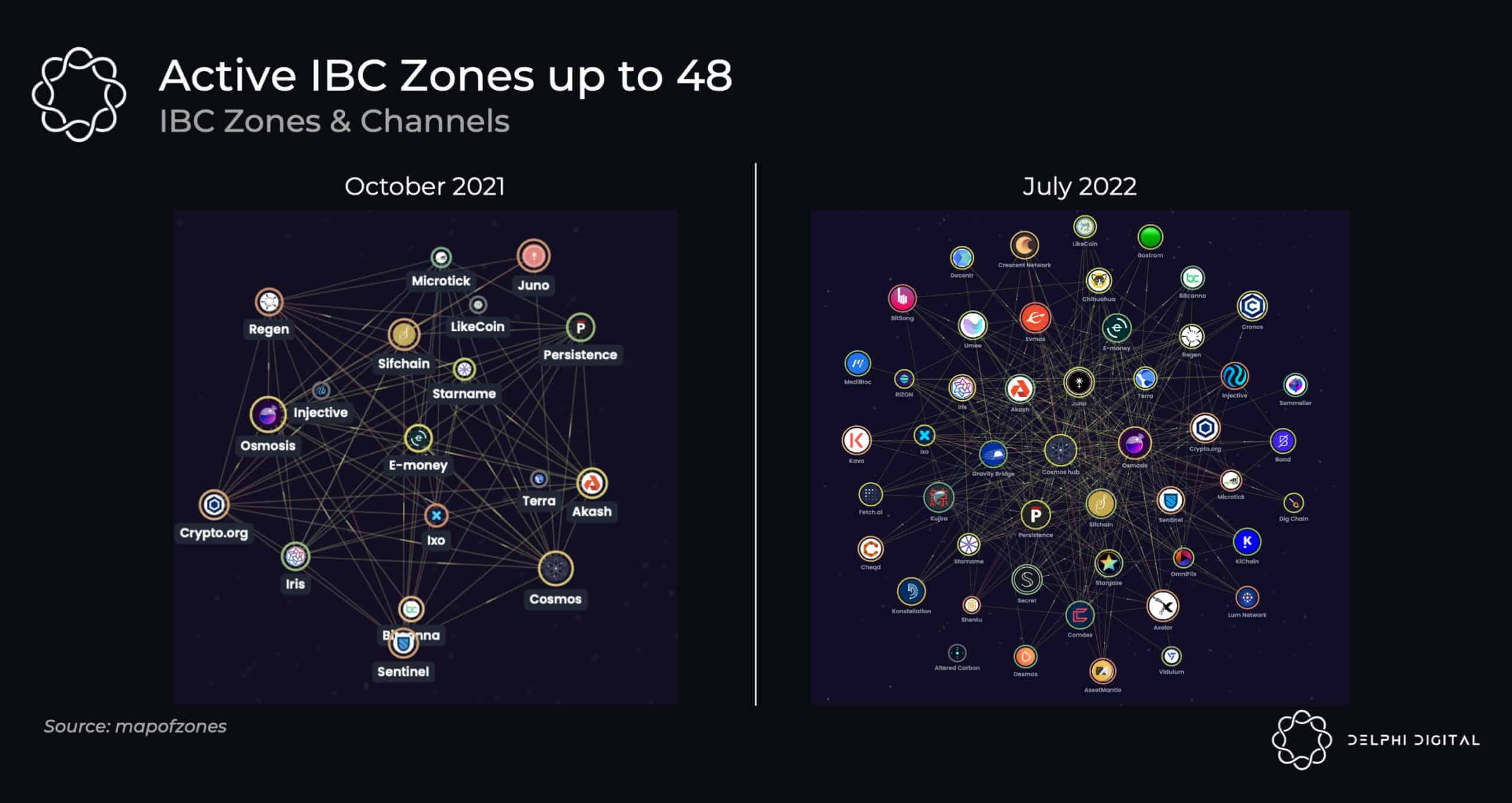
The technical achievement lies in the light client verification process. Each chain verifies the header of every other chain it connects to, ensuring trust-minimized communication. This means that a transaction on Osmosis can be verified on an EVM L2 without needing a third-party custodian. The result is a more resilient network where the failure of one chain does not compromise the integrity of the entire system.
Latest IBC Protocol Updates
The Inter-Blockchain Communication Protocol has matured from a basic packet-forwarding mechanism into a sophisticated middleware layer. By 2026, the focus shifted from simple token transfers to complex cross-chain computations, allowing chains like Osmosis to execute logic on remote validators without relying on centralized relayers. This evolution ensures that IBC remains the backbone of the Cosmos ecosystem, supporting everything from decentralized exchanges to modular data availability.
Middleware and Relayer Optimization
The introduction of the Relayer Middleware (RMW) standardized how light clients interact with remote chains. Instead of each application building its own trust model, middleware handles the verification of consensus states. This abstraction allows developers to focus on application logic rather than cryptographic proofs. For instance, when a user swaps assets on Osmosis from an IBC-enabled chain, the middleware ensures the proof of ownership is valid before executing the trade.
Light Client Efficiency
Light clients have become significantly lighter and faster. Early versions required downloading full block headers, which was bandwidth-intensive. New optimizations allow for efficient state proofs, reducing the data required to verify a transaction. This efficiency is critical for chains with high throughput, such as Celestia, which relies on IBC for secure data availability proofs. The reduced overhead means faster finality and lower gas costs for cross-chain transactions.
Security and Fault Tolerance
Security improvements have focused on fault tolerance and slashing conditions. The protocol now includes more robust mechanisms to detect and penalize malicious relayers. If a relayer submits a fraudulent proof, the light client can slash the relayer's stake. This economic incentive aligns the interests of relayers with the security of the network. Additionally, the protocol supports multiple light client types, allowing chains to choose the verification method that best fits their consensus algorithm.
Future-Proofing the Stack
The IBC protocol is designed to be agnostic to the underlying chain technology. Whether a chain uses Tendermint, CometBFT, or a novel consensus mechanism, IBC can facilitate communication as long as it implements the necessary light client interface. This flexibility ensures that new chains can join the network without requiring significant changes to the core protocol. The result is a resilient, interoperable ecosystem where value and data flow freely between diverse blockchain architectures.
IBC in decentralized finance 2026
Use this section to make the Cosmos IBC decision easier to compare in real life, not just on paper. Start with the reader's actual constraint, then separate must-have requirements from details that are merely nice to have. A practical choice should survive normal use, maintenance, timing, and budget. If a recommendation only works in an ideal situation, call that out plainly and give the reader a fallback path.
The simplest way to use this section is to write down the must-have criteria first, then compare each option against those criteria before weighing nice-to-have features.
How IBC ensures cross-chain security
IBC avoids the fragile middlemen that plague most cross-chain bridges. Instead of relying on multi-signature wallets or federated validators who could collude, IBC uses light clients and cryptographic proofs. This approach means each chain trusts the verification of another chain’s state directly, rather than trusting a third-party operator.
The core of this security model is the light client. Every IBC-enabled chain, such as Osmosis or Celestia, maintains a light client for its counterparty. This light client continuously verifies the header chain of the other network. It checks that the blocks are valid according to the consensus rules of the remote chain. If a malicious actor tries to submit a fraudulent packet, the light client will reject it because the cryptographic proof will not match the actual state of the source chain.
This trust-minimized design shifts the security burden. You are no longer betting on the honesty of a small group of bridge operators. You are betting on the cryptographic integrity of the blockchain itself. As long as the underlying consensus mechanism of the source chain remains secure, the cross-chain transfer is secure. This is why IBC is often described as the gold standard for interoperability: it removes the single points of failure that have led to billions in bridge hacks across the broader industry.
Frequently asked questions about IBC
What is IBC in Cosmos?
The Inter-Blockchain Communication Protocol (IBC) is a standardized protocol that allows independent blockchains to exchange data and tokens. Chains that implement IBC can share any type of data, provided it is encoded in bytes. This capability enables the industry's most robust cross-chain interactions, allowing assets to move between networks like Osmosis and Celestia without relying on centralized bridges.
Does IBC only transfer tokens?
No. While token transfers are the most common use case, IBC is a general-purpose communication layer. It can transmit arbitrary data, including smart contract execution instructions, governance votes, and state proofs. This flexibility allows developers to build complex cross-chain applications where logic is distributed across multiple Cosmos SDK chains.
How does IBC handle security?
IBC relies on light clients to verify the state of remote chains. Each participating chain maintains a light client for every other chain it communicates with, ensuring that packet validation is trustless and based on cryptographic proof. This architecture means that the security of a cross-chain transfer is anchored in the consensus security of the source and destination chains.
Can IBC connect to non-Cosmos chains?
Yes, through the IBC Relayer network and specific adapters. While IBC is natively designed for Cosmos SDK chains, projects like Polkadot and Ethereum have explored interoperability via relayers or wrapped representations. However, native IBC connectivity remains most seamless and secure within the Cosmos ecosystem, where light client efficiency is optimized.
No comments yet. Be the first to share your thoughts!