
Cosmos IBC Ecosystem Snapshot
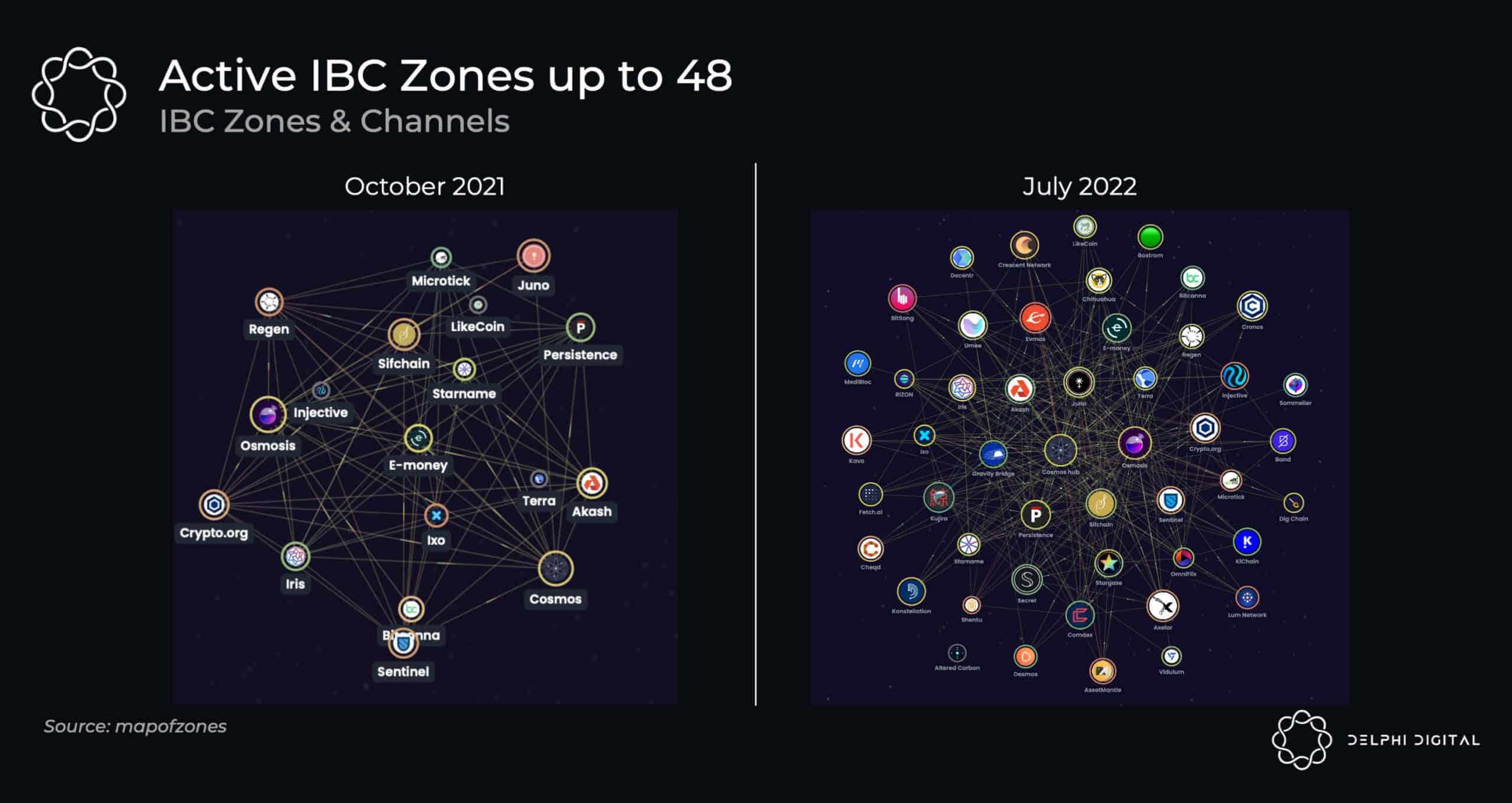
The Cosmos ecosystem has crossed a significant threshold, with the Inter-Blockchain Communication (IBC) protocol now connecting over 200 public networks. This scale marks a definitive shift from the early days of a few siloed hubs to a sprawling, multi-chain internet where independent blockchains can exchange data and value freely.
IBC serves as the standard for cross-chain communication, allowing chains to share any type of data encoded in bytes. This capability enables the industry’s most feature-rich interactions, moving beyond simple token swaps to complex, application-level interoperability. As the network expands in 2026, IBC is no longer limited to the Cosmos zone; it is integrating with Solana, EVM L2s, and other rollups through new IBC light clients.
This expansion transforms the Cosmos Stack from an isolated architecture into a central nervous system for the broader crypto economy. The growth to 200+ connections demonstrates that interoperability is no longer a niche feature but a foundational requirement for scalable blockchain infrastructure.
Interchain Security v2 upgrades
Interchain Security v2 transforms how new blockchains secure their networks. Instead of bootstrapping validators from scratch, new chains inherit security from the Cosmos Hub. This mechanism, formerly known as Shared Security, allows these chains to tap into the Hub’s robust validator set, significantly lowering the barrier to entry for developers.
By delegating stake to the Cosmos Hub’s validators, new chains gain immediate cryptographic assurance. This shared model reduces the time and capital required to launch a secure network. It also creates a unified security perimeter across the Cosmos ecosystem, ensuring that even smaller chains benefit from the same rigorous validation standards as the Hub.
The upgrade introduces more flexible economic models and improved slashing conditions. Validators can now participate in securing multiple chains simultaneously without compromising their primary duties. This efficiency boosts the overall resilience of the interchain, making it easier for new projects to launch with institutional-grade security.
For traders and developers, this means a more stable and interconnected ecosystem. As new chains integrate via Interchain Security, the liquidity and utility of the broader Cosmos network expand. This structural evolution supports the long-term growth of the IBC protocol, enabling seamless data and value transfer across diverse applications.
Cross-chain bridges to Solana and EVM
The 2026 expansion plan moves Cosmos IBC beyond its native SDK roots by introducing dedicated light clients for Solana and Ethereum L2s. This technical shift allows Cosmos chains to communicate with the two largest ecosystems by market capitalization, transforming IBC from a siloed protocol into a universal interchain standard. As noted in official Cosmos documentation, this expansion enables true interoperability by treating these external chains as first-class IBC participants rather than peripheral bridges.
Solana Integration
Integrating with Solana requires overcoming its unique account model and proof-of-history consensus. The new IBC light client for Solana allows Cosmos chains to verify Solana state transitions without relying on trusted third-party relayers. This native verification enables secure, trust-minimized transfers of SOL and SPL tokens across the interchain, significantly reducing latency and counterparty risk for high-value financial transactions.
Ethereum L2 Connectivity
Connecting to Ethereum L2s like Arbitrum, Optimism, and Base leverages IBC’s existing compatibility with EVM-compatible light clients. By verifying the state of these rollups directly, Cosmos chains can facilitate seamless asset transfers and data messaging with the broader Ethereum ecosystem. This integration is critical for liquidity aggregation, allowing DeFi protocols to tap into deep liquidity pools without exiting the IBC security model.
The addition of these light clients marks a pivotal moment for the Cosmos ecosystem. By bridging the gap between the Cosmos hub and the Solana and Ethereum ecosystems, IBC is positioned to become the primary layer for cross-chain interoperability. This expansion not only increases the utility of ATOM and other IBC-native assets but also solidifies Cosmos’s role as the connective tissue of the multi-chain future.
IBC and the RWA Liquidity Layer
The Inter-Blockchain Communication (IBC) protocol transforms Real-World Assets (RWA) from isolated on-chain tokens into liquid, cross-chain instruments. By allowing chains to share any data encoded in bytes, IBC creates a unified liquidity layer where assets can move without relying on centralized custodians or fragile wrapped-token bridges [src-serp-3]. This architecture is essential for high-stakes finance, where settlement finality and asset provenance must remain intact across heterogeneous environments.
For institutional players, the primary value of IBC lies in its ability to aggregate fragmented liquidity. Instead of capital being trapped in individual app-chains, RWA tokens such as tokenized treasuries or real estate can flow freely to the most efficient execution layer. This reduces slippage and improves capital efficiency for DeFi protocols that previously operated in silos.
The following table compares liquidity depth metrics between native Cosmos zones and traditional cross-chain bridge mechanisms. The data highlights the structural advantage of IBC’s native interoperability over wrapped-asset models.
| Metric | Native IBC | Cross-Chain Bridge | Risk Profile |
|---|---|---|---|
| Settlement Finality | Chain-native | Dependent on source | Low |
| Liquidity Depth | Aggregated | Fragmented | Medium |
| Counterparty Risk | Minimal | High (wrappers) | High |
| Technical Complexity | Standardized | Custom per pair | Variable |
This comparison underscores why IBC is becoming the preferred infrastructure for RWA tokenization. By eliminating the need for trusted wrappers, Cosmos chains enable a more robust and transparent liquidity market for real-world assets.
IBC Protocol Mechanics
The Inter-Blockchain Communication (IBC) protocol enables independent blockchains to exchange data and assets without a central intermediary. Defined by Interchain Standards (ICS), the protocol treats each connected chain as an independent sovereign entity, ensuring that trust assumptions remain localized rather than centralized.
Three core components drive this architecture. First, relayers are off-chain software agents that observe state changes on one chain and submit proofs to another. They do not hold funds or control transactions; they merely transport data packets between chains.
Second, light clients verify the authenticity of these proofs. Each chain maintains a light client for every other chain it communicates with, checking that the reported state matches the actual consensus of the remote chain. This allows chains to trustlessly validate incoming transactions without downloading the entire blockchain history.
Third, middleware allows applications to hook into the IBC path for custom logic. This layer enables features like token transfers with fees, atomic swaps, or packet filtering without altering the core protocol. Together, these elements form a modular system that scales as new chains join the interchain.
No comments yet. Be the first to share your thoughts!