
Tracking IBC network growth in 2026
The Cosmos IBC protocol has crossed a major threshold, now connecting over 200 public networks. This expansion marks a shift from a closed ecosystem of Cosmos-based chains to a broader interoperability layer. The Interchain Foundation recently highlighted that IBC now supports connections to Solana, EVM L2s, and various rollups through newly deployed light clients [1].
This growth is not just about quantity. The integration of non-Cosmos chains via light clients allows IBC to function as a universal bridge. Instead of relying on centralized validators or wrapped assets, IBC light clients verify the state of external chains directly. This approach maintains the security guarantees that made IBC the standard for Cosmos-based digital ledgers [3].
The market reflects this structural expansion. ATOM/USDT trading activity often correlates with announcements of new chain integrations, as traders position for increased liquidity flows across the interchain. The chart below shows recent price action, which has been influenced by both broader market sentiment and specific ecosystem developments.
As the network grows, the focus remains on seamless data transfer. IBC continues to serve as the backbone for an "Internet of Blockchains," enabling independent ledgers to communicate without compromising their sovereignty [3]. This architecture supports the next phase of multi-chain DeFi, where liquidity and users can move freely between distinct environments.
Relayer performance and infrastructure
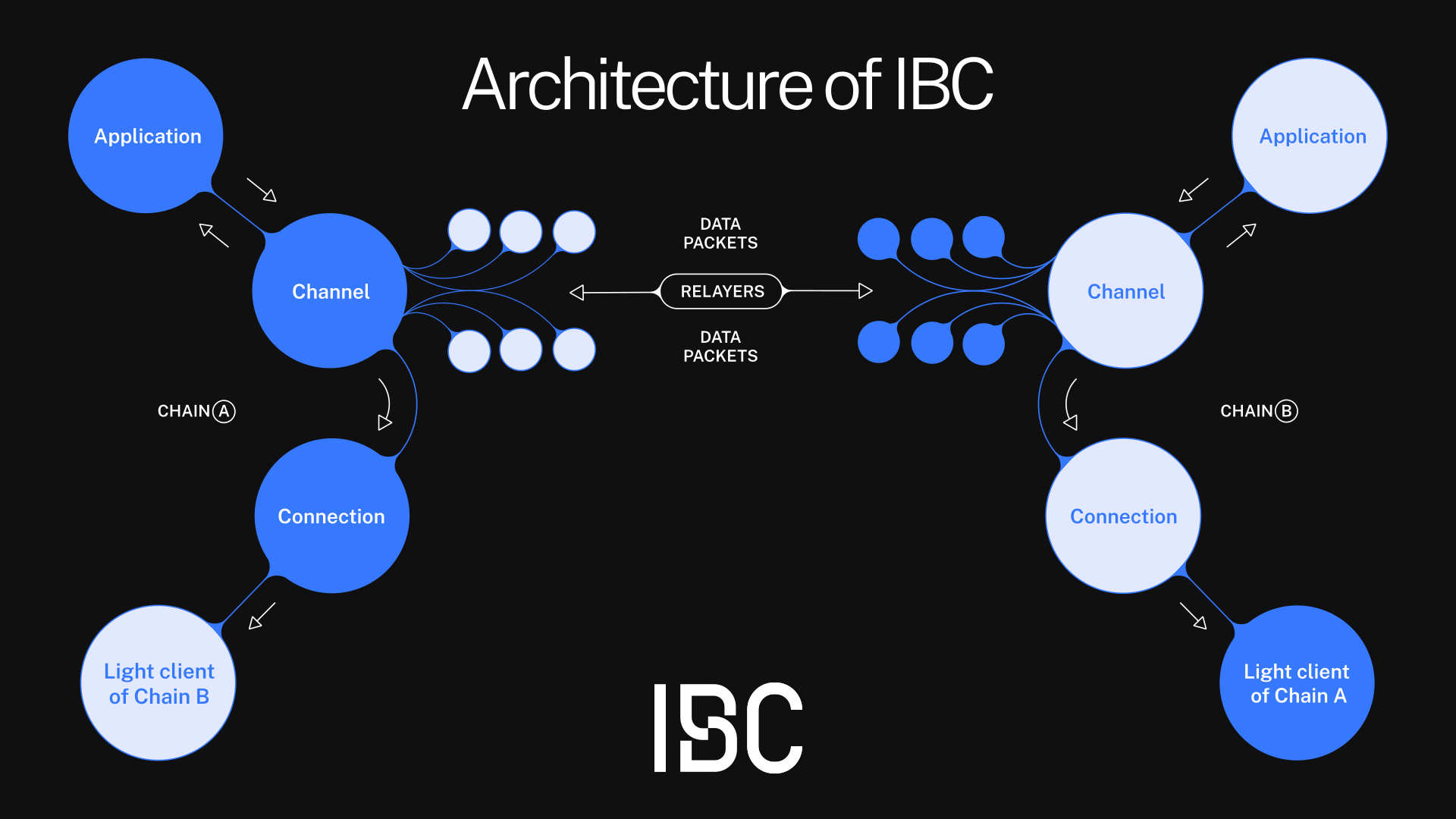
Relayers are the invisible couriers of the Cosmos network. Without them, IBC is just a protocol specification waiting in the void. These independent nodes monitor source chains for packet events, verify proofs, and deliver messages to destination chains. In 2026, the reliability of this layer determines whether multi-chain DeFi feels like a unified market or a fragmented puzzle.
The 2026 software updates focus on reducing latency and cutting operational costs. New relayer implementations use optimized light client verification, allowing faster finality for cross-chain transactions. This efficiency is critical for DeFi applications where price slippage can erase profits in seconds. The goal is to make cross-chain moves as instantaneous as internal transfers.
The infrastructure has also become more robust against downtime. Redundant relayer networks ensure that if one node fails, another picks up the slack immediately. This resilience is vital for maintaining trust in the IBC protocol. Developers can now build complex multi-chain strategies without worrying about packet delivery failures.
For the latest technical specifications on IBC-Go and relayer implementations, refer to the official Cosmos documentation. The open-source nature of these tools allows the community to continuously improve performance, ensuring that Cosmos remains a leader in interoperability.
Cross-chain liquidity in DeFi protocols
Inter-Blockchain Communication (IBC) solves the fragmentation that has long plagued decentralized finance. Before IBC, liquidity was trapped in silos. A user on Cosmos needed to wrap assets and route them through centralized exchanges or trust-minimized bridges to reach another chain, introducing latency and counterparty risk. IBC changes this by treating each blockchain as a sovereign node in a larger network, allowing tokens and data to move directly between ledgers.
This direct connectivity means DeFi protocols no longer need to compete for a single, thin pool of capital. Instead, they can tap into a shared liquidity layer. When a protocol on Osmosis wants to offer a stablecoin pair, it can pull liquidity from Terra or Axelar in real-time. This creates deeper order books and tighter spreads, mimicking the liquidity depth of centralized exchanges without the centralization risk.
The mechanism relies on light clients that verify the state of remote chains. When Chain A sends tokens to Chain B, the light client on Chain B verifies the transaction proof from Chain A. Once verified, the tokens are minted or unlocked on the destination chain. This process is atomic and deterministic, ensuring that assets are never stuck in limbo or exposed to bridge hacks that plague traditional cross-chain bridges.
Liquidity Depth and Transaction Costs
The difference in efficiency between native IBC transfers and traditional bridging methods is stark. Native transfers eliminate the need for wrapped assets and third-party custodians, significantly reducing both time and cost. The table below compares the typical metrics of these two approaches.
| Method | Trust Model | Avg. Transfer Time | Relative Cost |
|---|---|---|---|
| IBC Native | Light Client Verification | ~30 seconds | Low (Gas only) |
| Wrapped Bridge | Multi-sig / Oracle | 10-30 minutes | Medium-High |
| Centralized Exchange | Custodial | 1-24 hours | High (Fees + Slippage) |
| Atomic Swap (HTLC) | Hash Lock | 5-15 minutes | Medium |
By removing the middleman, IBC allows capital to flow where it is needed most, instantly. This fluidity is essential for the next generation of DeFi, where composability across chains is not a luxury but a requirement for sustainable growth.
Institutional adoption and enterprise use
Cosmos IBC is transitioning from a speculative crypto experiment to a foundational layer for institutional finance. Financial institutions are increasingly leveraging IBC for compliant, secure cross-chain data and asset transfers. This shift moves the ecosystem beyond retail trading, focusing on enterprise-grade interoperability that meets regulatory standards.
The Inter-Blockchain Communication protocol provides a standardized way for independent blockchains to exchange packets of data and tokens. For enterprises, this means they can build applications that span multiple ledgers without relying on centralized bridges, which are often targets for exploits. The architecture supports secure state verification, ensuring that assets moving between chains remain verifiable and auditable.
Major financial players are exploring these capabilities for cross-border payments and institutional DeFi. By using IBC, institutions can access deep liquidity pools across different Cosmos zones while maintaining control over their data and assets. This approach reduces counterparty risk and operational complexity compared to traditional cross-chain solutions.
The technology stack, as outlined by the Interchain Foundation, is designed for scalability and security. This makes it suitable for high-volume transaction environments typical in institutional finance. As adoption grows, IBC is becoming the de facto standard for secure interoperability in the multi-chain DeFi landscape.
No comments yet. Be the first to share your thoughts!