
What is the Cosmos IBC protocol
The Inter-Blockchain Communication (IBC) protocol is a standardized method for independent blockchains to exchange data and tokens directly. Unlike traditional cross-chain bridges that rely on centralized validators or wrapped assets, IBC enables trust-minimized communication between chains that may use entirely different consensus mechanisms and virtual machines.
At its core, IBC operates as a byte-level communication standard. It does not dictate how individual chains process transactions or manage state. Instead, it defines a rigid set of rules for how chains prove the validity of data to one another. When Chain A wants to send information to Chain B, it does not guess or hope the data arrives. It uses IBC to send packets of data, which Chain B verifies against its own record of Chain A's state. This verification process ensures that both sides of the communication agree on the current reality of the network, preventing double-spends and data inconsistencies.
This architecture allows for a wide range of cross-chain applications. Developers can build token transfers, atomic swaps, and multi-chain smart contracts that execute across multiple networks simultaneously. The protocol essentially creates a private internet for blockchains, where each chain retains its sovereignty and security model while gaining access to a broader ecosystem of liquidity and utility.
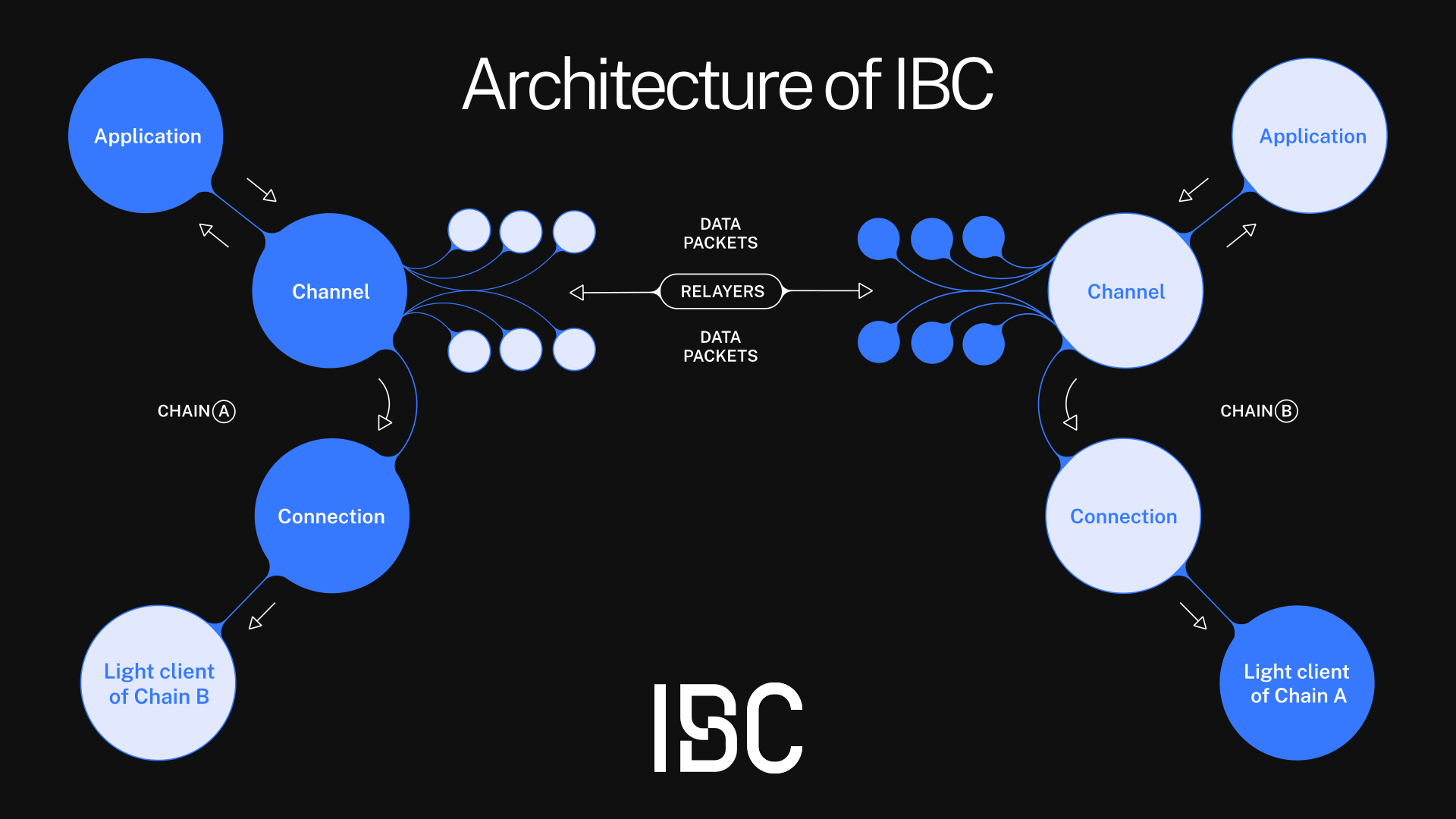
The absence of centralized intermediaries is what sets IBC apart. In a typical bridge scenario, users must trust a third party to hold their assets and issue corresponding tokens on another chain. IBC removes this counterparty risk. The security of the transfer relies entirely on the cryptographic proofs generated by the source and destination chains themselves. If a chain is compromised, the IBC protocol detects the invalid state change and rejects the associated packets, protecting the connected networks from the fallout.
By treating blockchains as peers rather than hierarchical layers, IBC fosters a modular ecosystem. Chains can specialize in specific functions—such as high-throughput execution or privacy—while relying on IBC to handle the heavy lifting of communication. This modularity is foundational to the Cosmos vision of an "Internet of Blockchains," where interoperability is a built-in feature rather than an afterthought.
How relayers move packets
Relayers are the operational backbone of the Inter-Blockchain Communication (IBC) protocol. They are independent software nodes that monitor blockchains for new events, construct IBC packets, and submit cryptographic proofs to finalize transfers. Unlike validators, who secure their own chains through consensus, relayers do not participate in block production or validation. They act as neutral messengers, ensuring that state changes on one chain are recognized and executed on another.
The process begins when a transaction occurs on the source chain, such as a token transfer. The relayer detects this event by reading the latest block headers and transaction data. It then packages the relevant data into an IBC packet, which includes the sender, receiver, amount, and timeout height. This packet is not submitted to the source chain again; instead, it is held in memory, waiting for the destination chain to acknowledge it.
To finalize the transfer, the relayer must prove that the source chain actually processed the transaction. It does this by fetching a light client proof from the source chain’s state. This proof is a cryptographic commitment that verifies the data’s existence without requiring the destination chain to trust the relayer. The relayer submits this proof along with the packet to the destination chain’s IBC module.
Once the destination chain verifies the proof against its light client representation of the source chain, it updates its own state. The tokens are locked or burned on the source side and minted or unlocked on the destination side. This atomic swap ensures that assets move securely across the interchain without requiring a centralized intermediary.
This mechanism allows Cosmos chains to communicate regardless of their underlying consensus type. As long as both chains implement the IBC protocol, they can exchange any data encoded in bytes. The relayer’s role is purely mechanical: observe, package, prove, and submit. This separation of concerns allows the Cosmos ecosystem to scale horizontally, with each chain focusing on its specific state machine while relying on relayers for connectivity.
IBC expansion to Solana and EVM
The Inter-Blockchain Communication (IBC) protocol is undergoing its most significant architectural shift since its inception. Moving beyond its origins as a Cosmos-native standard, IBC is evolving into a multi-ecosystem hub. This expansion addresses the fragmentation of the broader blockchain landscape by enabling direct, trust-minimized communication between independent chains that previously operated in isolation.
The core mechanism driving this change is the implementation of IBC light clients. A light client is a compact software module that verifies the consensus state of a remote blockchain without needing to download the entire ledger. By integrating these clients into the Cosmos Hub and other IBC-enabled chains, the network can cryptographically verify transactions and state updates from Solana and various EVM L2s. This removes the need for centralized bridges or trusted relayers, which have historically been the primary vectors for cross-chain exploits.
Connecting to Solana
Solana’s integration represents a major leap in throughput and finality for the interchain. Historically, connecting Solana to the Cosmos ecosystem required complex wrapped asset solutions that often relied on centralized custodians. With the new IBC light client, the Cosmos Hub can directly observe Solana’s proof-of-history consensus.
This connection allows for native asset transfers where the underlying token remains on Solana, while a representation is minted or locked on the receiving chain. The light client ensures that any attempt to double-spend or create fraudulent states on Solana is rejected by the Cosmos chain, maintaining security without sacrificing Solana’s high-speed transaction capabilities.
Bridging EVM L2s
The expansion into Ethereum Layer 2s (L2s) follows a similar logic but addresses the specific finality mechanisms of rollups. IBC light clients for EVM L2s verify the validity proofs or fraud proofs generated by these rollups. This creates a secure path for assets and data to flow between the Ethereum ecosystem and the Cosmos ecosystem.
For developers, this means they can build applications that leverage the security of Ethereum’s L1 settlement while utilizing the composability and speed of Cosmos-based chains. The protocol effectively turns disparate L2s into part of a unified, interconnected network, allowing liquidity and data to move freely without leaving the security guarantees of their respective origins.

This multi-ecosystem approach transforms IBC from a specialized tool for Cosmos chains into a universal standard for blockchain interoperability. By supporting Solana and EVM L2s, the protocol reduces friction for users and developers who no longer need to navigate a maze of fragmented bridges to access liquidity across different technological stacks.
Middleware and application layers
The base IBC protocol provides the transport layer, but middleware components allow developers to build complex cross-chain applications on top of it. These modules abstract the low-level packet handling, enabling features like remote account control and automated token transfers without requiring every chain to implement custom logic.
Interchain Accounts (ICA)
Interchain Accounts enable one chain to control an account on another chain. This allows validators or smart contracts to execute transactions remotely, facilitating automated governance actions, staking operations, or smart contract interactions across the interchain. ICA removes the need for manual bridging or manual signing for every cross-chain action.
Token Transfers
The IBC token transfer module is the most widely used middleware component. It allows native tokens to move between chains while preserving their original denomination and value. This module handles the escrow and minting/burning mechanics, ensuring that tokens remain pegged correctly as they traverse the network. It forms the backbone of liquidity sharing across the Cosmos ecosystem.
Cross-Chain Applications
By combining these middleware layers, developers can create atomic swaps, multi-chain smart contracts, and decentralized exchanges. These applications leverage the security and finality of IBC to operate across multiple independent blockchains as if they were a single unified network.
No comments yet. Be the first to share your thoughts!