
What is Cosmos IBC?
Cosmos IBC (Inter-Blockchain Communication) is a protocol that enables separate blockchains to send tokens and data to one another directly. It operates without relying on centralized intermediaries or third-party custodians, allowing independent chains to communicate as if they were part of a single network. This direct communication model distinguishes IBC from traditional bridge solutions that often require locking assets in centralized contracts.
The protocol achieves this trust-minimized security through light clients and relayers. Each participating chain maintains a light client for every other chain it communicates with, verifying proofs of state without needing to trust a central operator. Relayers, which are independent nodes, observe these light clients and submit proofs to execute messages across the network. This architecture ensures that no single party controls the flow of assets or data between chains.
IBC serves as the foundational layer for the Cosmos ecosystem, enabling a wide range of cross-chain applications. These include simple token transfers, atomic swaps, and multi-chain smart contracts. By standardizing how chains interact, IBC allows developers to build applications that leverage the unique features of multiple blockchains while maintaining security and interoperability.
The 2026 Expansion Beyond Cosmos
Inter-Blockchain Communication (IBC) has transitioned from a Cosmos-native protocol to a general-purpose interoperability standard. In 2026, the Interchain Stack is no longer confined to the Cosmos ecosystem. It now connects EVM L2s, Solana, and other major networks through specialized light clients, creating a trust-minimized mesh rather than a centralized hub-and-spoke model.
The core mechanism relies on light clients, which are lightweight programs that verify the consensus state of a remote blockchain. Instead of trusting a third-party bridge operator, IBC nodes validate proofs directly against the source chain’s state. This approach eliminates the single points of failure common in traditional wrapped asset bridges. Relayers then package these proofs and submit them to the destination chain, ensuring that messages and tokens move securely across heterogeneous environments.
This expansion allows developers to build applications that span multiple ecosystems without sacrificing security. For example, an application can now use IBC to interact with Solana accounts or Ethereum L2s as if they were native Cosmos chains. The protocol handles the complexity of different consensus mechanisms and data structures, providing a unified interface for cross-chain communication.
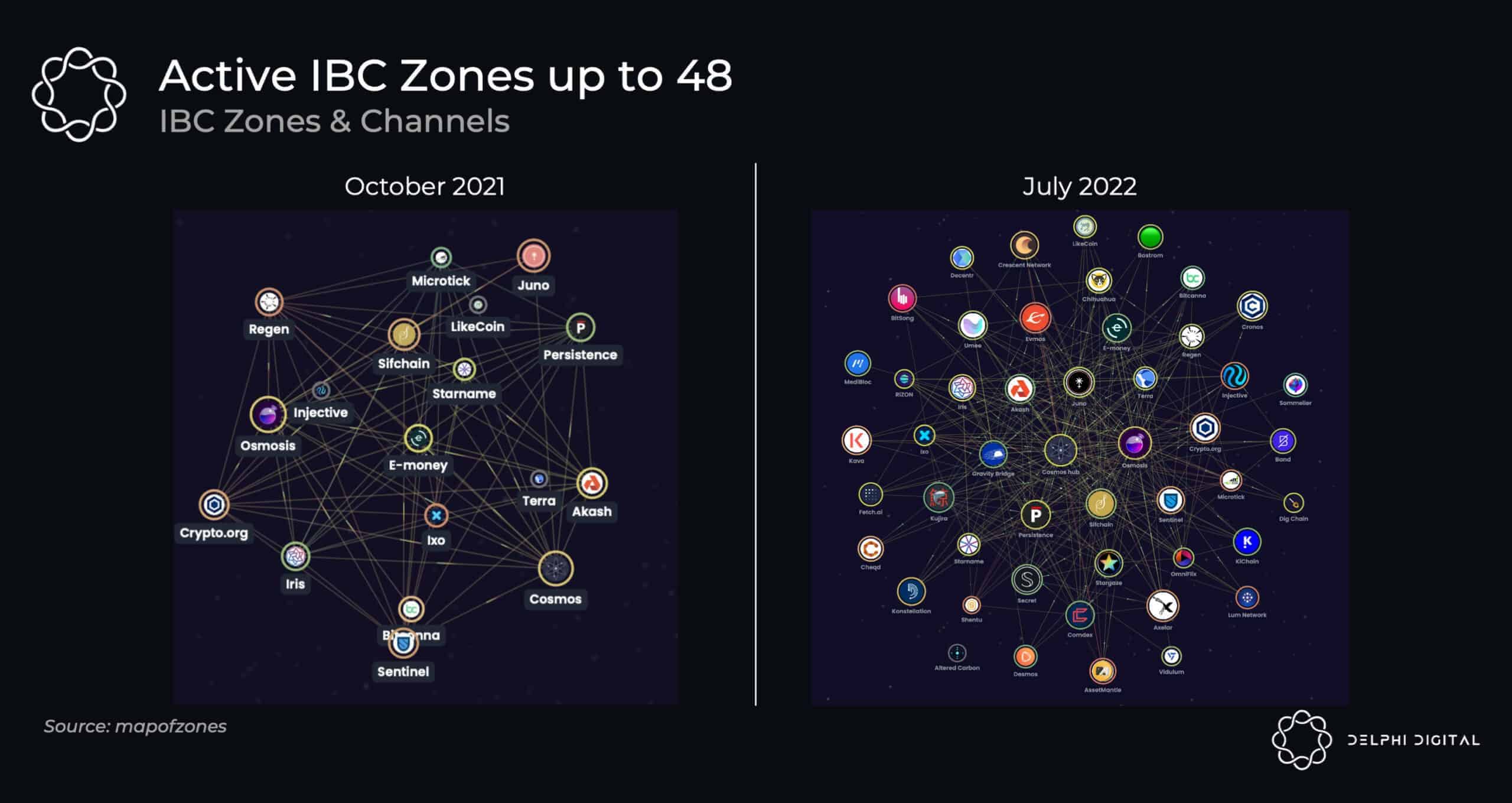
The growth of this network is significant. IBC now connects over 200 public networks, including dozens of EVM rollups and non-Cosmos chains. This scaling demonstrates the protocol’s adaptability and its role as a foundational layer for the broader interchain economy.
How IBC Relayers Work
Relayers are the independent software agents that make the Inter-Blockchain Communication (IBC) protocol function. They are not custodians of user funds, nor do they hold private keys for the chains they connect. Instead, relayers act as data couriers, listening for new state changes on one chain and transmitting those updates to another. This separation of data transmission from asset custody is what allows IBC to remain trust-minimized; users retain full control of their assets while relying on cryptographic proofs rather than centralized intermediaries to ensure delivery.
The core responsibility of a relayer is to observe the state of a source chain and submit that information to a destination chain. When a transaction occurs on Chain A, the relayer detects the change and constructs a packet containing the necessary data. Crucially, the relayer also gathers a light client proof—a cryptographic commitment that the data originated from the correct chain. This proof allows the destination chain to verify the authenticity of the packet without needing to trust the relayer itself. If the proof is valid, the destination chain executes the corresponding action, such as unlocking tokens or updating a balance.
This process is driven by economic incentives. Relayers incur gas fees on both the source and destination chains for submitting transactions. To compensate for these costs and provide a profit margin, users or applications pay relayers a fee for reliable packet delivery. This market-driven model ensures that there is always economic motivation for operators to run high-quality relayer nodes. The network remains secure because malicious relayers cannot forge proofs; any attempt to submit invalid data is rejected by the light clients on the destination chain, resulting in a loss of the relayer’s stake or fees.
The reliability of the interchain depends on the availability of these relayers. If no relayer is active for a specific channel, packets will queue up and fail to deliver, effectively freezing cross-chain communication. However, because the system is open, anyone can run a relayer, creating a competitive market for speed and reliability. This decentralization of relayer infrastructure prevents any single entity from becoming a bottleneck or a point of failure, aligning with Cosmos’ broader vision of a sovereign, interconnected network of blockchains.
How IBC Security Works
The Inter-Blockchain Communication protocol secures cross-chain transfers through a trust-minimized model that relies on two core mechanisms: light clients and slashing conditions. Unlike centralized bridges that hold assets in custodial wallets, IBC verifies chain state directly on the destination chain. This approach ensures that neither the sending nor receiving chain needs to trust a third party to validate the movement of tokens or data.
Light Client Verification
Security begins with the light client, a lightweight proof verification tool that tracks the header and state of a remote chain. When Chain A sends a message to Chain B, Chain B runs a light client for Chain A to verify that the transaction was actually included in a valid block. This verification process uses Merkle proofs, which are cryptographic guarantees that specific data exists within a larger dataset without requiring the entire dataset to be downloaded.
This mechanism allows Chain B to trustlessly confirm the state of Chain A. If a malicious actor attempts to forge a transaction or alter history, the light client will reject the invalid proof. This eliminates the need for multi-sig wallets or validator committees, reducing the attack surface significantly compared to traditional bridging solutions.
Relayer Incentives and Slashing
While light clients verify the data, relayers are responsible for transmitting the proofs between chains. Relayers are independent actors who monitor for new blocks, package the necessary proofs, and submit them to the destination chain. To prevent relayers from ignoring messages or submitting fraudulent proofs, the IBC protocol employs a slashing mechanism.
If a relayer submits a proof that the light client rejects, or if they fail to perform their duties as defined by the channel’s governance parameters, they can be slashed. Slashing involves the confiscation of staked tokens, creating a strong economic disincentive for malicious behavior. This aligns the relayer’s interests with the network’s security, ensuring that honest participation is rewarded and dishonesty is costly.
No comments yet. Be the first to share your thoughts!