
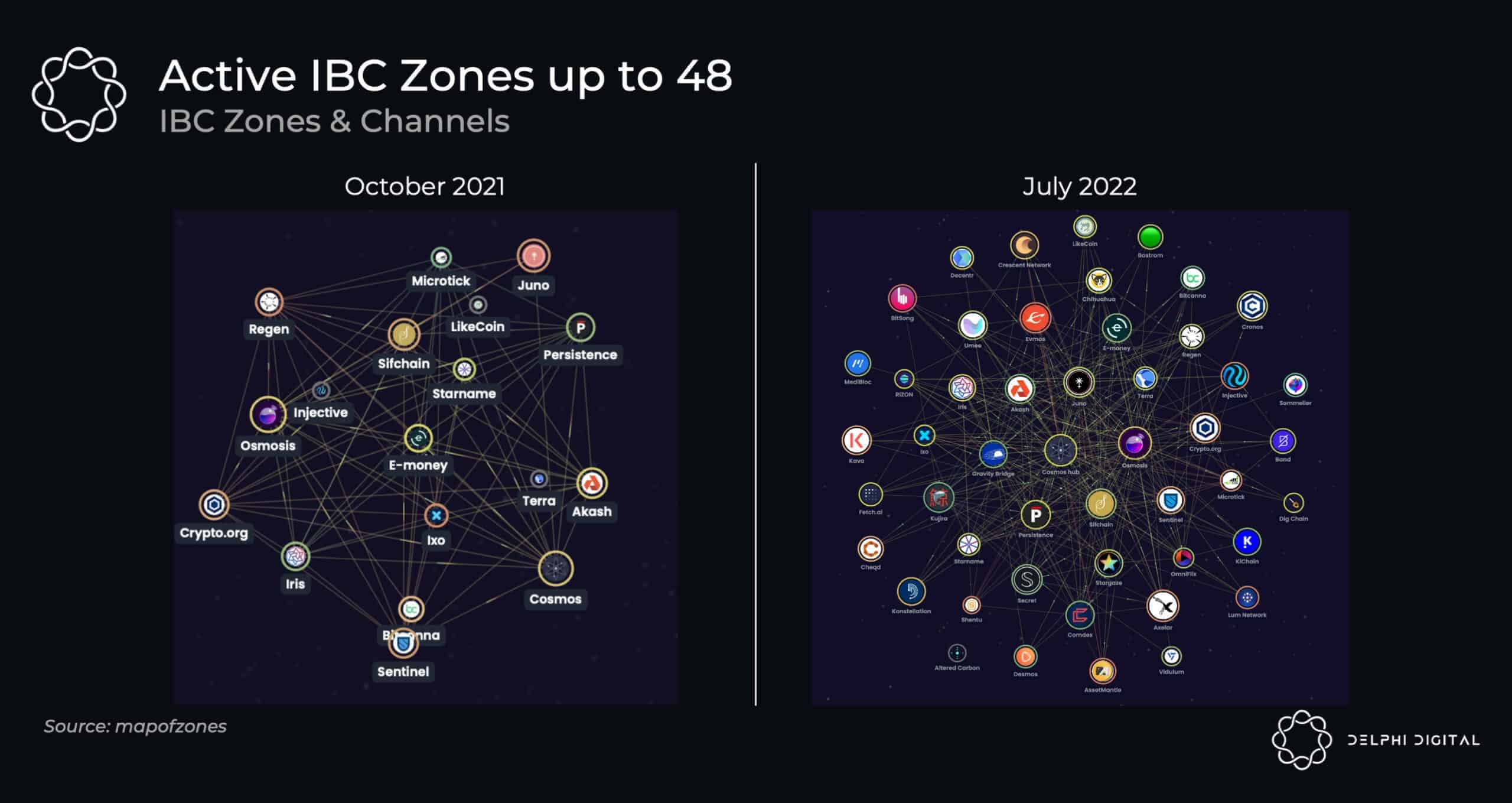
IBC expansion beyond the Cosmos ecosystem
The Inter-Blockchain Communication (IBC) protocol has long been the backbone of the Cosmos network, enabling secure data and asset transfers between sovereign blockchains. However, by 2026, IBC is no longer confined to the Cosmos ecosystem. It is actively connecting to external chains, including Solana and Ethereum L2s, marking a significant shift in interoperability standards.
This expansion allows IBC to reach over 200 public networks. New IBC light clients now support connections to rollups and other non-Cosmos chains. This development enables institutions to leverage IBC’s security model across a broader range of infrastructure.
The integration with Solana and EVM L2s demonstrates IBC’s adaptability. It is no longer just a protocol for Cosmos-based ledgers but a framework for cross-chain communication. This growth underscores the increasing demand for secure, performant blockchain solutions in the financial sector.
New IBC Light Clients for External Chains
The 2026 expansion of the Inter-Blockchain Communication (IBC) protocol relies on a critical technical shift: the integration of native light clients for non-Cosmos chains. Previously, IBC was largely confined to the Cosmos ecosystem, where chains shared similar Tendermint-based consensus mechanisms. This new architecture allows IBC to securely verify state on external ledgers, including Solana, EVM L2s, and various rollups, enabling trust-minimized asset transfers across previously disconnected networks.
At its core, an IBC light client is a smart contract deployed on the destination chain that tracks the header state of a source chain. Instead of trusting a centralized validator or a multi-sig wallet, the light client cryptographically verifies proofs generated by the source chain’s consensus. For EVM chains, this typically involves verifying Merkle proofs against the chain’s state root, while for non-Tendermint chains like Solana, it requires verifying specific consensus signatures or stake-weighted proofs. This mechanism ensures that the transferring chain can independently confirm that a transaction occurred on the source chain without relying on third-party oracles.
This development marks a significant departure from earlier cross-chain bridges, which often relied on federated models with higher security risks. By embedding verification logic directly into the destination chain, IBC reduces the attack surface for bridge exploits. The protocol now connects over 200 public networks, as confirmed by recent Cosmos announcements, effectively turning the Cosmos Hub into a central liquidity hub for a fragmented multi-chain landscape. The technical complexity lies in standardizing these verification proofs across vastly different consensus models, but the result is a more robust and interoperable financial infrastructure.
The implementation of these light clients is governed by the Interchain Standards (ICS) documented in the official Cosmos IBC repository. This ensures that any new chain integrating with IBC must adhere to strict security and compatibility guidelines. As the ecosystem matures, the ability to seamlessly move assets between Ethereum, Solana, and Cosmos-based chains without custodial intermediaries represents a fundamental upgrade in decentralized finance security and efficiency.
Cross-chain DeFi liquidity reshaped
The expansion of the Inter-Blockchain Communication (IBC) protocol fundamentally alters how liquidity flows across the Cosmos ecosystem. By replacing fragmented bridging mechanisms with a standardized, light-client-based security model, IBC reduces the friction and risk that typically isolate capital in siloed environments. This shift enables assets to move seamlessly between independent blockchains, creating a unified liquidity pool that behaves more like a single, cohesive market than a collection of disconnected islands.
Traditional cross-chain solutions often rely on trusted intermediaries or complex wrapping mechanisms, which introduce counterparty risk and centralization points. IBC eliminates these vulnerabilities by using light clients to verify state transitions directly. This cryptographic assurance allows liquidity providers to allocate capital across multiple chains with confidence, knowing that the underlying security guarantees remain intact regardless of the destination chain. The result is a more efficient capital allocation model where assets are not trapped in low-yield environments but can flow to where they are most needed.
| Feature | Traditional Bridges | IBC Light Client Model |
|---|---|---|
| Security Model | Trusted multisig or federations | Cryptographic light client verification |
| Trust Assumption | High (relies on operator honesty) | Minimal (relies on code and math) |
| Asset State | Wrapped or locked in vaults | Native transfer with proof |
| Fragmentation Risk | High (liquidity split across hubs) | Low (direct peer-to-peer routing) |
This architectural advantage is critical for high-stakes DeFi applications where security is paramount. By minimizing the attack surface associated with bridge hacks, IBC encourages larger institutional participants to engage with cross-chain protocols. As liquidity becomes less fragmented, the depth of order books increases, reducing slippage for large trades and improving overall market stability. The Cosmos Stack, as described by the Interchain Foundation, is designed specifically to support this scalable and secure interconnectedness, positioning IBC as the backbone of next-generation financial infrastructure.
The implications extend beyond simple asset transfers. Smart contracts on one chain can now directly interact with liquidity pools on another, enabling complex financial primitives that were previously impossible due to connectivity barriers. This interoperability fosters innovation by allowing developers to build on specialized chains while accessing liquidity from the broader ecosystem. As the network matures, the cumulative effect of these connections will likely drive significant volume growth, making IBC a critical component for any serious DeFi strategy.
Institutional adoption and tokenization
The 2026 IBC standard shifts Cosmos from a collection of experimental chains to a regulated financial backbone. By treating interoperability as a compliance layer rather than just a technical feature, the network addresses the primary barrier to institutional entry: trustless settlement across jurisdictions. This evolution allows asset issuers to move tokenized real-world assets (RWAs) with the same certainty as traditional wire transfers, but without the intermediary friction.
For financial infrastructure, the key innovation is the standardization of the Inter-Blockchain Communication protocol. IBC is no longer just about moving tokens; it is about moving verified state. This enables atomic swaps between sovereign blockchains that maintain their own regulatory boundaries. An institution can hold assets on a permissioned chain while settling liquidity on a public Cosmos hub, ensuring that compliance checks are enforced at the point of issuance and transfer, not just at the exchange.
This architecture supports a hybrid model where private ledgers can interoperate with public networks. The Cosmos Stack provides the tools for builders to create Layer 1s that are both secure and interconnected. As noted by the Interchain Foundation, this allows for scalable, secure blockchain applications that can integrate with existing financial systems. The result is a network where tokenization is not an isolated experiment but a native function of the broader internet of blockchains.
Common questions about IBC and Cosmos
The Inter-Blockchain Communication (IBC) protocol is the foundational interoperability framework within the Cosmos SDK ecosystem. It enables independent blockchains to exchange data and assets directly, without relying on centralized bridges or third-party validators. This architecture allows ledgers with different consensus mechanisms to communicate securely, establishing a standard for cross-chain connectivity that integrates with existing financial infrastructure.
What does IBC stand for in Cosmos?
IBC stands for Inter-Blockchain Communication. It is a protocol that allows separate blockchains to send tokens and data to one another directly. By standardizing the rules for these exchanges, IBC ensures that assets and information can move across the Cosmos network while maintaining security and finality, effectively breaking down silos between independent ledgers.
What is Cosmos IBC?
Cosmos IBC is the interoperability framework native to Cosmos-based digital ledgers. It supports the transfer of data and assets across these ledgers by establishing a set of rules and conventions for communication. This framework allows blockchains to interact seamlessly, enabling developers to build applications that leverage liquidity and functionality from multiple chains simultaneously.
Is Cosmos its own blockchain?
The Cosmos Hub is a specific blockchain within the broader Cosmos Network, powered by the ATOM coin. It utilizes a proof-of-stake consensus method that allows participants to stake ATOM and earn rewards. Rather than being a single monolithic chain, the Cosmos Hub acts as a central hub designed to interconnect thousands of other blockchain systems, facilitating a scalable "internet of blockchains."
No comments yet. Be the first to share your thoughts!