
What is Cosmos IBC in 2026
Cosmos IBC (Inter-Blockchain Communication) is the protocol enabling trustless data and asset transfers between independent blockchains. In 2026, it serves as the foundational layer for the Cosmos ecosystem, allowing chains to communicate without centralized custodians or wrapped assets.
How IBC-Go Moves Data and Tokens
IBC-Go is the reference implementation of the protocol. It handles packet verification and state synchronization, ensuring that transfers are verifiable and immutable.
The protocol relies on a four-part model: clients, connections, channels, and packets.
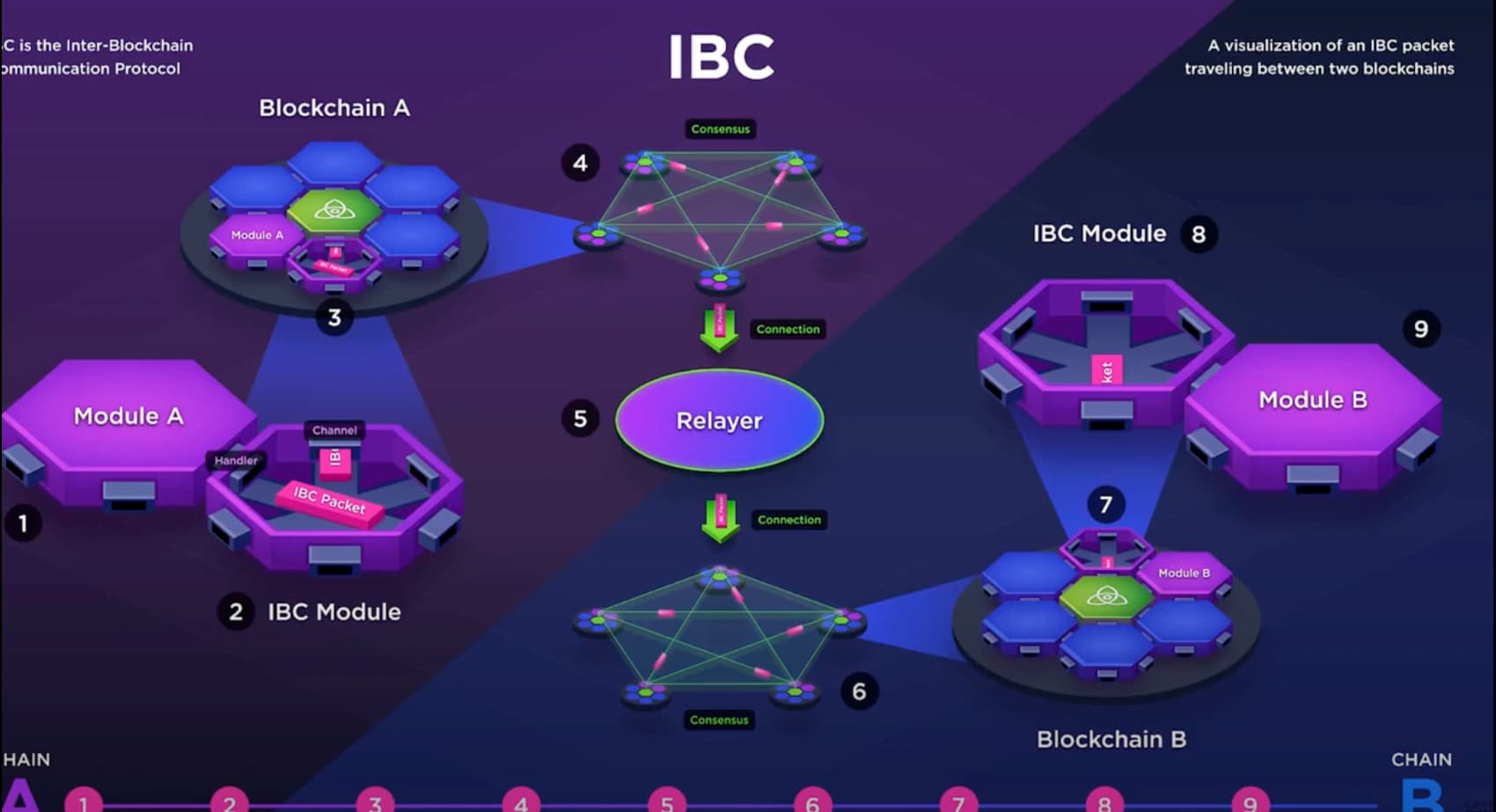
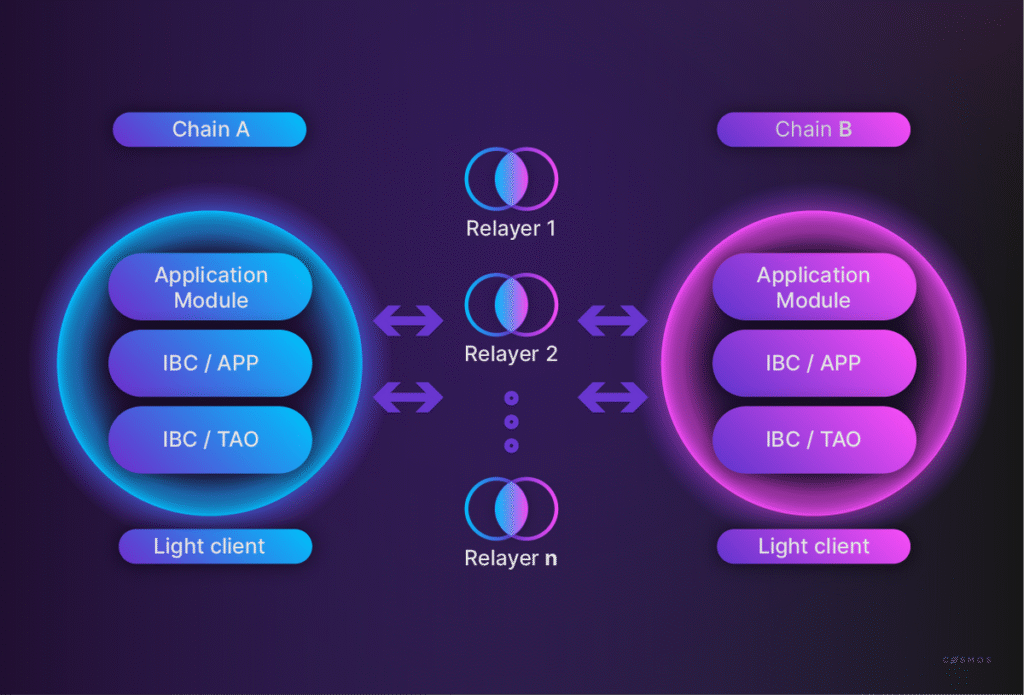
A client is a light client running on one chain that verifies the state of another. It acts as a trust anchor, allowing Chain A to prove that specific data exists on Chain B. Without a client, a chain cannot natively trust external state updates.
Once clients are in place, a connection is opened between the two chains. This is a logical link that maps the clients to each other. It does not yet allow data transfer; it simply confirms that the two chains know how to talk to each other.
Channels are built on top of connections and handle the actual messaging. They are ordered and reliable, meaning packets must be delivered in the same sequence they were sent. This prevents replay attacks and ensures state consistency.
Data is wrapped in packets and sent over the channel. The receiving chain verifies the packet against its client. If the proof is valid, the receiving chain updates its state accordingly. If not, the packet is rejected.
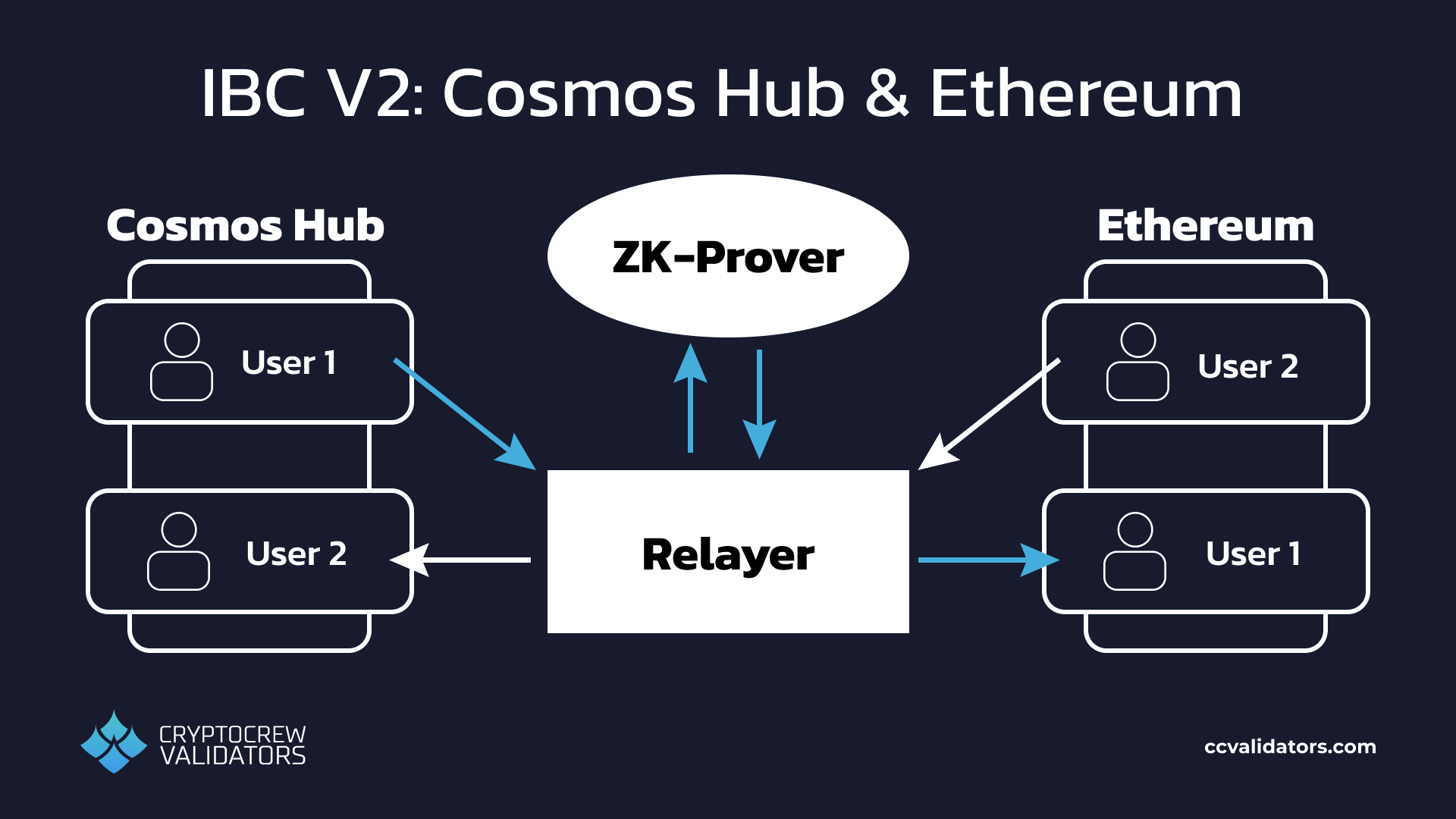
This model eliminates the need for trusted relayers to hold funds. Instead, security is derived from the cryptographic proofs verified by the light clients. The relayer’s only job is to pass the packets between chains; it cannot alter the data or steal the assets.
Relayers and the Interchain Stack
Relayers are off-chain services that monitor IBC events and submit proofs to the respective chains. Because the protocol is trustless, relayers do not control the assets; they merely facilitate the communication. This separation of duties ensures that even if a relayer goes offline or acts maliciously, the funds remain secure on the source chain until the proof is verified.
IBC Applications and Middleware
By 2026, the protocol has moved beyond simple asset transfers to power a diverse range of applications across the interchain. These applications allow developers to build complex logic that spans multiple blockchains, effectively turning isolated networks into a unified ecosystem. The Cosmos SDK repository has consolidated these modules into ibc-go, ensuring that developers have a single, maintained source for the most critical middleware and app modules.
Token Transfers and Native Assets
The most common use of IBC is the transfer of native tokens between chains. Unlike traditional bridges that lock assets on one chain and mint wrapped versions on another, IBC transfers move the actual native tokens. This method preserves the original security model of the source chain. For example, a user can send ATOM from the Cosmos Hub to a different zone without relying on a third-party custodian or a synthetic wrapped asset. This direct movement of value reduces counterparty risk and simplifies the user experience.
Atomic Swaps and Trustless Trading
IBC enables atomic swaps, which allow users to exchange assets on different chains without trusting a centralized intermediary. The protocol ensures that the trade either completes fully on both chains or not at all. This feature is particularly valuable for interoperability between the Cosmos ecosystem and the EVM (Ethereum Virtual Machine) space. As IBC expands into EVM L2s and rollups, developers can build decentralized exchanges that facilitate trustless trading across these distinct environments. This capability is a core part of the 2026 expansion, connecting Cosmos to over 200 public networks.
Multi-Chain Smart Contracts
Advanced IBC middleware supports multi-chain smart contracts, allowing logic to execute across multiple blockchains simultaneously. This means a single application can manage state and funds across different chains, enabling use cases like cross-chain governance or complex financial derivatives. The expansion into Solana and other non-Cosmos chains in 2026 further broadens these possibilities. Developers can now build applications that leverage the specific strengths of different networks, such as Cosmos's speed and Solana's throughput, without sacrificing interoperability.
Comparison: IBC vs. Traditional Bridges
| Feature | IBC Applications | Traditional Bridges |
|---|---|---|
| Security Model | Relies on the security of the source and destination chains. | Often relies on a centralized validator set or smart contract risk. |
| Asset Type | Transfers native tokens directly. | Typically locks assets and mints wrapped derivatives. |
| Trust Assumption | Trustless, based on cryptographic proofs. | Varies; often requires trust in the bridge operator. |
| Speed | Deterministic finality based on chain speeds. | Can be slow due to additional verification steps. |
The table above highlights why IBC is preferred for many developers seeking a more secure and efficient interchain experience. As the ecosystem grows, these applications will continue to evolve, supporting a wider array of decentralized services.
Cosmos Hub upgrades and ATOM in 2026
The Cosmos Hub remains the central anchor of the interchain ecosystem, evolving from a standalone chain into the primary security provider for the network. In 2026, Interchain Security allows independent blockchains to lease security from the Hub, reducing the need for every new chain to bootstrap its own validator set. This model has stabilized the ecosystem, allowing hundreds of chains to operate with shared protection rather than isolated risk.
ATOM tokenomics have shifted to support this structure. While the token still serves as governance and gas for the Hub, its value accrual is increasingly tied to the demand for security services. Validators stake ATOM to secure the Hub, and these stakes are shared with consumer chains. This creates a direct economic link between Hub health and the broader interchain activity.
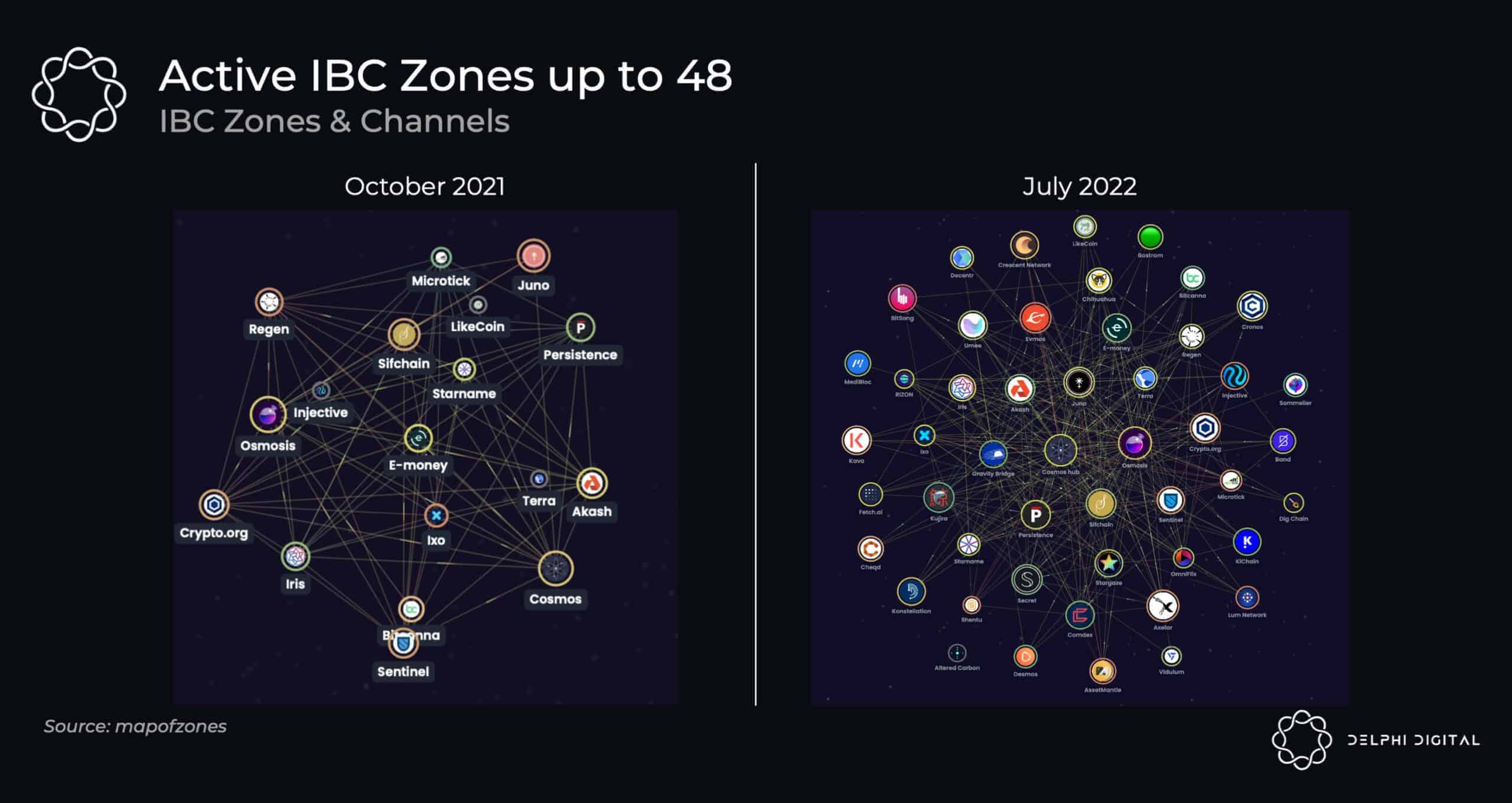
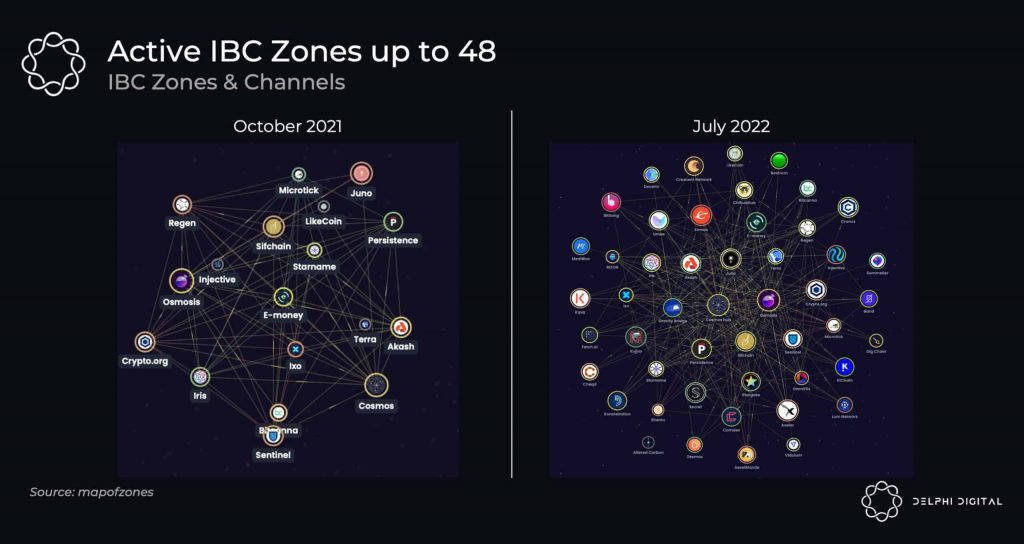
The network continues to expand its reach, with IBC connecting over 200 public networks. This connectivity ensures that the Hub remains relevant not just as a settlement layer, but as the critical infrastructure enabling interoperability across diverse blockchain environments.
Frequently asked questions about Cosmos and IBC
Does Cosmos have a future in 2026?
The Cosmos ecosystem continues to expand its modular blockchain architecture. By prioritizing interoperability over monolithic scaling, Cosmos allows developers to build specialized blockchains that communicate securely. This modular approach remains a distinct alternative to single-chain networks, ensuring relevance as the industry seeks scalable, interoperable solutions.
How does IBC actually work?
IBC functions like a standardized postal system for blockchains, enabling secure data and token transfers between independent networks without a central intermediary. It uses light clients to verify proofs of state from other chains, ensuring that assets moving from Chain A to Chain B are locked or burned before being minted or released on the destination. This mechanism allows for trustless communication, meaning users do not need to trust a third party to facilitate the transfer.
Who are the main competitors to Cosmos?
Cosmos competes primarily with other interoperability-focused ecosystems like Polkadot and cross-chain messaging protocols such as LayerZero. While Polkadot uses a shared security model with a central relay chain, Cosmos relies on independent sovereign blockchains connected via IBC. Other competitors include Avalanche’s subnet architecture and various bridge-based solutions, though these often introduce different security trade-offs regarding trust assumptions and centralization risks.
What is the latest news on Cosmos (ATOM)?
Recent developments in the Cosmos ecosystem focus on upgrading the IBC protocol to support enhanced security features and cross-chain account abstractions. The ATOM token continues to evolve within the interchain security model, where it can be staked to secure other chains in the ecosystem. Updates to the Cosmos SDK and CometBFT consensus engine regularly introduce performance improvements and new capabilities for developers building on the network.
No comments yet. Be the first to share your thoughts!