
What is cosmos ibc in 2026
The Inter-Blockchain Communication (IBC) protocol is the foundational layer that allows separate blockchains to send tokens and data to one another directly. Unlike generic cross-chain bridges that often rely on centralized validators or wrapped assets, IBC establishes a trust-minimized connection between independent networks. This means that chains can communicate without needing to trust a third party to hold their funds or validate their transactions.
At its core, IBC operates through a series of connection and channel handshakes. Before any application can transfer assets or data, the participating chains must first establish a verified path. This process ensures that both sides of the communication agree on the state of the other chain, creating a reliable pipe for value and information. The protocol handles the complex logistics of locking assets on one chain and minting representations on another, all while maintaining security guarantees derived from the underlying consensus mechanisms.
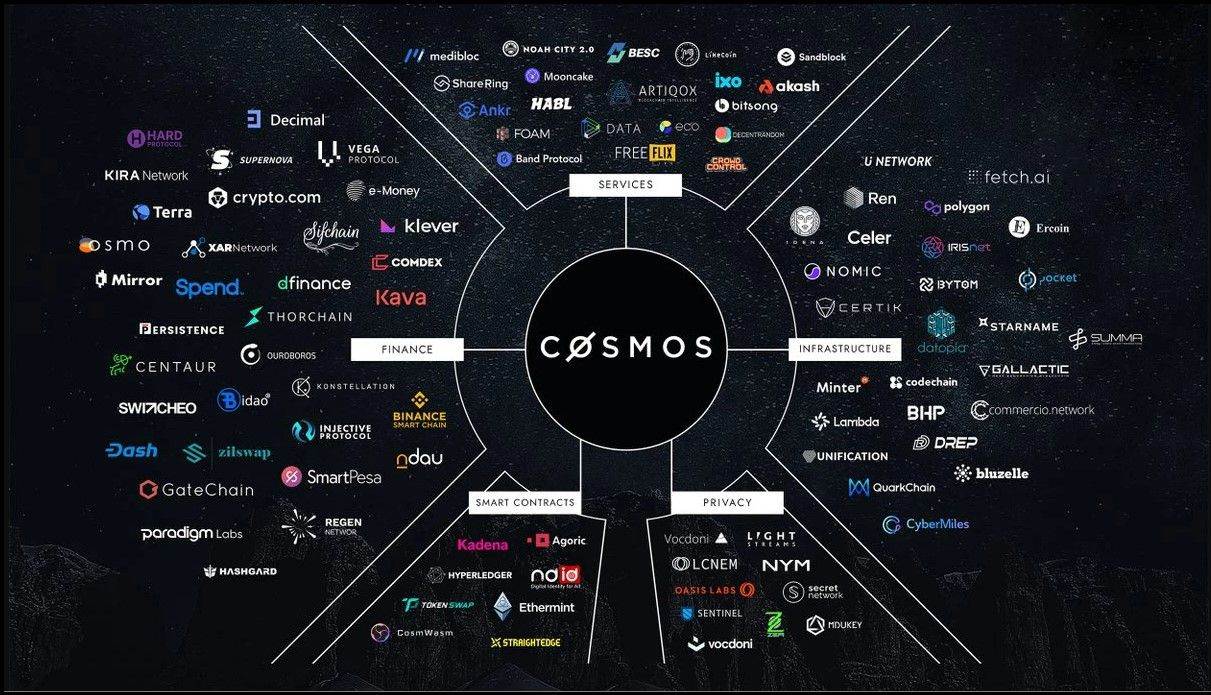
By removing the need for centralized intermediaries, IBC enables a truly modular blockchain ecosystem. Projects built on the Cosmos SDK can focus on their specific use cases while leveraging the shared security and connectivity provided by IBC. This architecture allows for a vibrant network of specialized chains, from high-throughput payment networks to privacy-focused ledgers, all interacting as part of a single, cohesive internet of blockchains.
How interchain security shifts staking
Cosmos 2.0 introduces a fundamental change to how blockchains secure their networks. Instead of every new chain recruiting its own set of validators, the Hub can lease its security to consumer chains. This model, known as Interchain Security, allows smaller projects to tap into the Hub’s validator set and ATOM stake immediately upon launch.
Previously, a new blockchain had to bootstrap its security from scratch. This "cold start" problem often resulted in weak security and vulnerable networks that struggled to attract users. By connecting to the Cosmos Hub, consumer chains inherit the robustness of the main network. Validators who secure the Hub can now also validate for these consumer chains, earning additional rewards for their work.
This shared security model creates a more efficient ecosystem. Validators no longer need to split their resources thinly across dozens of low-stake chains. Instead, they can allocate their computational power and capital where it is most impactful. Consumer chains benefit from higher security guarantees without the lengthy process of building a validator community.
The mechanism works through the IBC protocol. When a consumer chain connects, it specifies the minimum amount of ATOM staking power required. The Hub’s governance module oversees this relationship, ensuring that consumer chains adhere to the security parameters set by the Hub. If a consumer chain fails to meet these requirements, the Hub can disconnect it, protecting the overall network integrity.
This approach scales security rather than diluting it. As more consumer chains join the ecosystem, the demand for ATOM staking increases, potentially strengthening the economic security of the entire Cosmos network. It transforms the Hub from a simple relay into the central security anchor for the interchain landscape.
Multi-chain DeFi strategies
IBC transforms how developers and users interact with decentralized finance. Rather than treating blockchains as isolated silos, IBC enables them to communicate directly, allowing for atomic swaps, cross-chain liquidity, and unified interfaces across app-specific chains.
Atomic swaps and trustless execution
Atomic swaps are the backbone of IBC’s security model. An atomic swap ensures that two transactions either complete entirely or fail entirely, with no intermediate state. This eliminates the need for trusted third parties or complex bridging mechanisms that often introduce vulnerabilities.
For example, a user can swap Cosmos (ATOM) for Osmosis (OSMO) across different chains without relying on a centralized exchange. The transaction is verified by both chains’ light clients, ensuring that funds are never left exposed in transit. This trustless execution is documented in the official Cosmos IBC documentation, which outlines how IBC handles packet acknowledgment and timeout scenarios.
Cross-chain liquidity pools
Liquidity fragmentation has long been a challenge in DeFi. IBC addresses this by allowing liquidity to flow freely between chains. Developers can build cross-chain liquidity pools where assets from multiple chains contribute to a single yield-generating strategy.
This approach reduces slippage and improves capital efficiency. Users can access deep liquidity without needing to move assets through multiple hops or centralized intermediaries. The Supra Academy guide explains how IBC facilitates these transfers, emphasizing the protocol’s role in enabling data and value movement.
Unified interfaces for app-specific chains
App-specific chains offer tailored functionality, but they can fragment the user experience. IBC solves this by allowing a single interface to interact with multiple chains. Users can manage assets, execute trades, and monitor positions across different networks without switching wallets or dashboards.
This unification is critical for mainstream adoption. It simplifies the complexity of multi-chain DeFi, making it accessible to users who may not be familiar with the underlying blockchain mechanics. By abstracting away the complexity, IBC enables a more cohesive and user-friendly DeFi ecosystem.
Cosmos ecosystem growth metrics
The expansion of the Cosmos network in 2026 is defined by the adoption of Interchain Security rather than isolated chain growth. This shift has allowed the ecosystem to scale its security budget across a wider array of applications without requiring each chain to build its own validator set from scratch.
Active chains and transaction volume
The number of connected zones has increased as more projects leverage shared security. This connectivity drives transaction volume, as assets move fluidly between chains that previously operated in silos. The IBC protocol handles this traffic, making the network effectively larger than the sum of its individual parts.
Developer activity and infrastructure
Development activity remains concentrated on the Cosmos SDK, which provides the foundational tools for building new chains. This focus on infrastructure ensures that new projects can launch quickly while maintaining compatibility with the existing interchain. The result is a steady pipeline of new applications that rely on the core network's stability.
Key takeaways
- Interchain Security has replaced isolated chain growth as the primary driver of ecosystem expansion.
- Connected zones are driving higher transaction volumes through increased asset mobility.
- The Cosmos SDK continues to attract developers by simplifying the process of building compatible chains.
common questions about ibc
The Inter-Blockchain Communication (IBC) protocol acts as the connective tissue for the Cosmos ecosystem. It allows independent blockchains to exchange tokens and data directly, without relying on centralized intermediaries or complex bridging mechanisms. Understanding these mechanics clarifies how the "Internet of Blockchains" functions in practice.
No comments yet. Be the first to share your thoughts!