
What defines Cosmos IBC in 2026
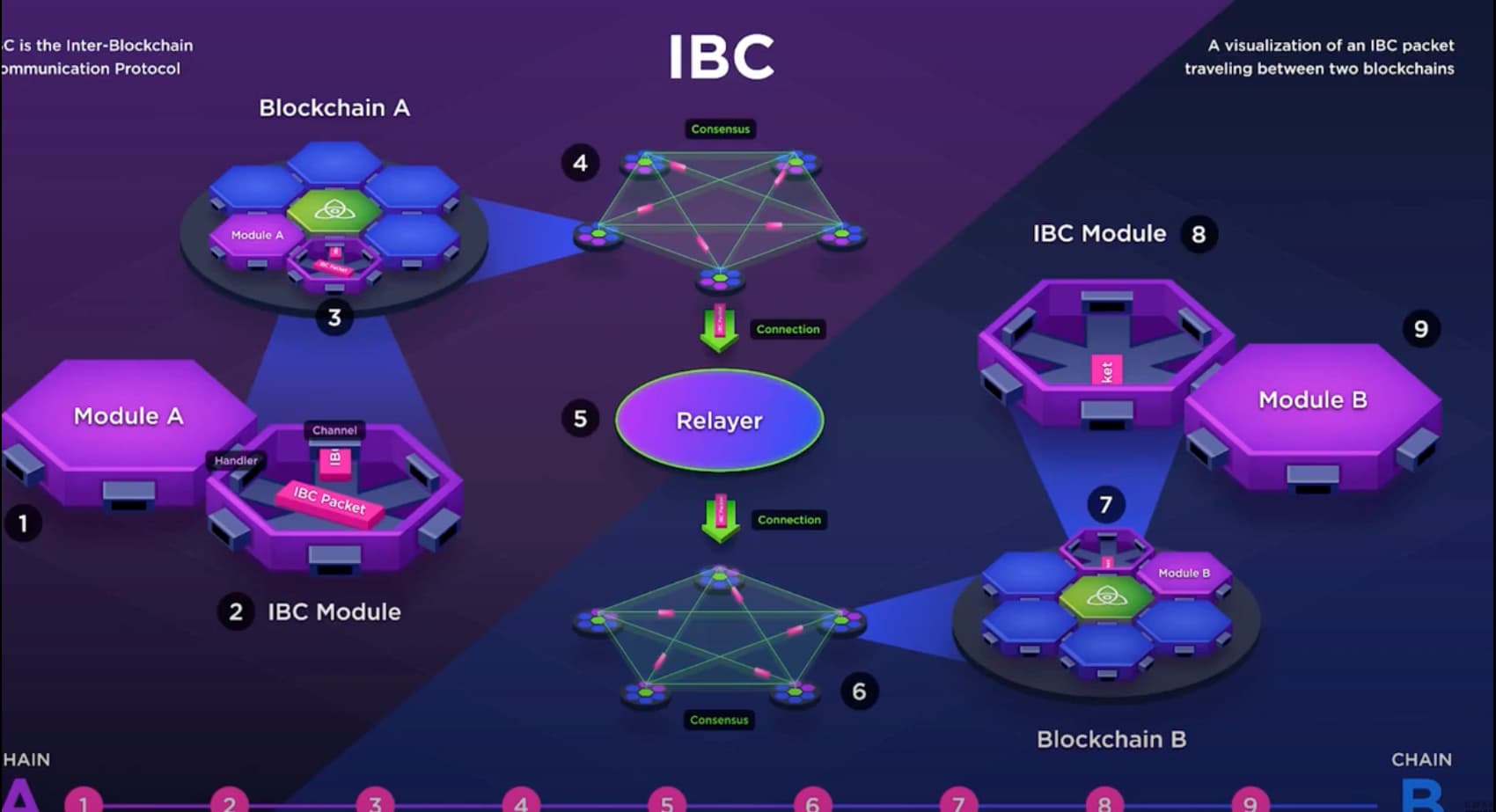
Cosmos IBC 2026 represents a fundamental shift from a localized networking protocol to a universal standard for cross-chain communication. Originally designed as the backbone for the Cosmos ecosystem, the Inter-Blockchain Communication protocol has evolved into a critical bridge connecting diverse blockchain environments. It is no longer confined to Cosmos-based ledgers but now facilitates seamless interaction with Ethereum Virtual Machine (EVM) chains and Solana.
The core function of IBC remains the secure transfer of data and assets between independent blockchains. However, its application has expanded significantly. Developers now use IBC to build complex cross-chain applications, including atomic swaps, multi-chain smart contracts, and decentralized exchanges that operate across multiple ecosystems. This versatility allows sovereign blockchains to maintain their independence while accessing liquidity and functionality from other networks.
The scale of this connectivity is substantial. As of 2026, IBC connects over 200 public networks and dozens of private consortiums. This growth underscores its role as an interoperability layer that transcends its original boundaries. By enabling communication between EVM L2s, rollups, and Solana, the protocol addresses the fragmentation that has long plagued the crypto industry.
This expansion marks a departure from the "islands" model of early blockchain development. Instead, it supports an interconnected internet of blockchains where value and information flow freely. The protocol's ability to integrate with legacy infrastructure and existing financial systems further cements its position as a foundational element of the modern digital asset landscape.
Key projects shaping the IBC landscape
The Cosmos ecosystem has evolved from a single hub into a network of specialized chains, each leveraging the Inter-Blockchain Communication (IBC) protocol to solve specific problems. In 2026, the focus has shifted from mere connectivity to interoperable utility, where distinct chains handle asset issuance, decentralized exchange, and modular data availability.
Osmosis: Liquidity Aggregation
Osmosis remains the largest decentralized exchange within the Cosmos ecosystem. It functions as a liquidity hub, allowing any IBC-enabled chain to access deep pools of capital without building its own order book. By automating liquidity provision, Osmosis ensures that assets moving across the network can be swapped efficiently, reducing friction for users navigating between sovereign chains.
Celestia: Modular Data Availability
Celestia represents the shift toward modular blockchain architecture. Rather than handling both consensus and execution, it specializes in data availability, providing a secure and scalable layer for other chains to publish their transaction data. This specialization allows execution layers to focus on speed and security while relying on Celestia for integrity, a model that is increasingly adopted by new Cosmos SDK chains.
Noble: Native Asset Issuance
Noble has positioned itself as the native asset issuance layer for IBC. It supports the issuance and transfer of stablecoins like USDC and USDY directly across the network. By optimizing its infrastructure for asset transfers, Noble reduces the latency and cost associated with moving stable value, making it a preferred choice for financial applications requiring fast, reliable cross-chain settlements.
Band Protocol: Cross-Chain Data
Band Protocol acts as the oracle layer for the ecosystem, aggregating real-world data and making it accessible to any IBC-enabled chain. Its cross-chain data hub allows smart contracts on different blockchains to consume verified information, such as price feeds or weather data, without relying on centralized sources. This capability is essential for DeFi applications that require accurate, external data inputs.
Mantra: Regulatory-Compliant Chains
Mantra focuses on building regulatory-compliant blockchain infrastructure. By integrating native compliance tools directly into its chain architecture, it appeals to institutional players and traditional finance entities looking to enter the Cosmos ecosystem. This approach demonstrates how IBC can support chains with specific legal requirements, broadening the appeal of the network beyond purely decentralized participants.
Relayer Optimization and Infrastructure
The Cosmos IBC 2026 landscape relies on a decentralized network of relayers to function. These nodes act as the physical bridges between independent blockchains, listening for events on one chain and submitting proofs to another. Without this middleware, the IBC protocol would remain a theoretical standard rather than a working interoperability stack. The efficiency of these relayers directly impacts transaction speed and cost, making their infrastructure a critical component of the ecosystem.
The modules in the cosmos/ibc-apps repository have been consolidated into cosmos/ibc-go. The older repository is no longer actively maintained and will be archived on 2026-08-03, signaling a maturation of the developer stack.
For developers, this consolidation simplifies integration. The ibc-go module provides a robust, standardized interface for building IBC-enabled applications within the Cosmos SDK. By centralizing the core logic, the Cosmos team ensures that new chains can interoperate with existing networks without reinventing the wheel. This standardization reduces the risk of security vulnerabilities and promotes consistency across the ecosystem.
Relayer software, such as Hermes or IBC-go-relayer, automates the heavy lifting of message passing. These tools monitor light clients for state changes and execute the necessary transactions to update proof states on destination chains. As the network grows, the competition among relayer providers drives down fees and improves uptime, ensuring that data transfer remains secure and efficient for all participants.
Cross-chain liquidity and asset flows
Liquidity in the Cosmos ecosystem moves through the Inter-Blockchain Communication (IBC) protocol, which allows separate blockchains to send tokens and data directly without centralized intermediaries. This architecture creates a unified liquidity layer where assets from different zones can interact seamlessly. The result is a network where value isn't trapped in silos but flows freely to where it is most needed.
The user experience of this connectivity is managed through multi-chain portals. These interfaces abstract the complexity of bridging, allowing users to swap, stake, or transfer assets across chains as if they were on a single ledger. For the average participant, this means lower friction and faster transaction finality compared to traditional cross-chain bridges that rely on wrapped tokens and custodial risks.
Economic incentives drive this volume. Networks compete to offer the deepest order books and lowest fees, attracting traders and developers who want to maximize capital efficiency. As more chains integrate via IBC, the aggregate liquidity pool grows, reducing slippage for large trades and encouraging more complex financial applications to build on the stack.
Understanding how these flows work helps clarify why Cosmos IBC 2026 represents a significant shift in how we view blockchain interoperability. The following table compares the primary mechanisms used to move liquidity across the interchain.
Expanding beyond the hub
The Cosmos IBC 2026 roadmap signals a major shift from a closed garden to an open highway. While IBC originally connected sovereign zones within its own ecosystem, the protocol is now actively bridging to external networks. This expansion includes direct connections to EVM L2s and the Solana blockchain, effectively turning Cosmos into a universal interoperability layer rather than just a collection of independent chains.
These integrations are critical for the longevity of the ATOM token. As IBC becomes the standard for cross-chain communication across disparate ecosystems, ATOM’s role as the central hub and security provider for these connections grows more valuable. The network effect strengthens as more assets and users flow through IBC from non-Cosmos chains, driving demand for staking and governance.
This evolution supports a broader multi-chain narrative where no single blockchain dominates. Instead, specialized chains communicate seamlessly via IBC, creating a cohesive internet of value. For developers and users, this means access to liquidity and functionality across Solana, Ethereum, and Cosmos without the friction of centralized bridges.
IBC’s expansion into Solana and EVM L2s marks a pivotal moment for the Cosmos ecosystem, positioning it as the connective tissue for the entire multi-chain future.
No comments yet. Be the first to share your thoughts!